
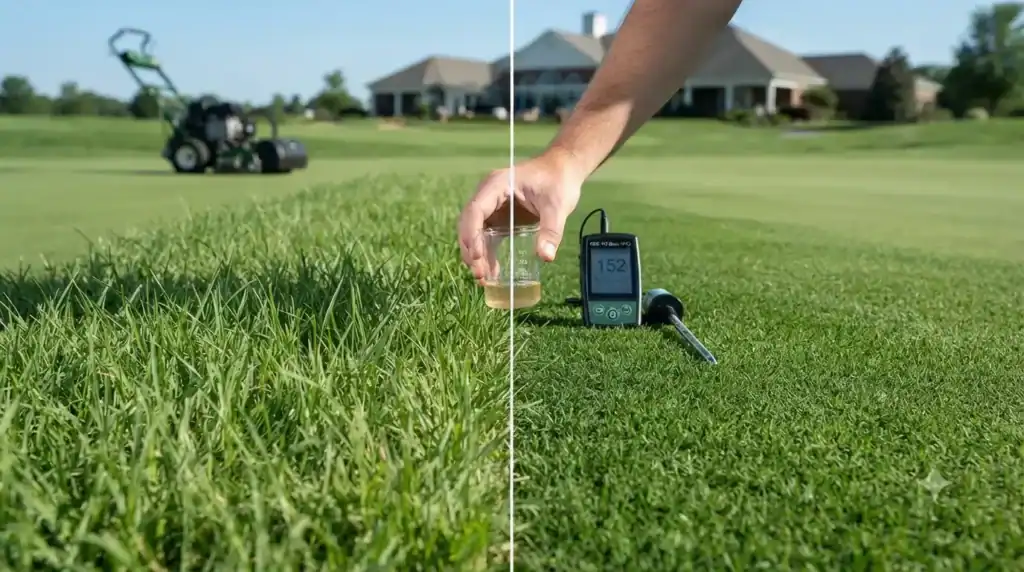

By 2026, modern greenkeeping innovation has shifted entirely from a philosophy of “force” to one of “precision.” We no longer manage turf simply by how hard we can push it, but by how deeply we understand the underlying biological systems. Nowhere is this precision more crucial than in the orchestration of Plant Growth Regulators (PGRs).
Once viewed merely as a chemical shortcut to reduce mowing frequencies, Integrating PGRs have evolved into fundamental turf conditioning tools. When integrated properly, they dictate carbohydrate allocation, maximize root development, improve shade tolerance, and significantly boost stress resilience.
However, maximizing the potential of these compounds requires moving past calendar-based scheduling. To truly master PGR integration, greenkeepers must combine physiological literacy with precise data tracking. This is the advanced guide to taking your PGR program to the next level.
1. Understanding the Mechanics: Type A vs. Type B Regulators
To manage a PGR program efficiently, you must first target the right hormonal pathways. Modern fine-turf management relies primarily on two categories of gibberellic acid (GA) inhibitors:
- Type A Inhibitors (Late-Stage GA Pathway): Compounds like Trinexapac-ethyl (e.g., Primo Maxx) work late in the gibberellin biosynthesis pathway. They inhibit cell elongation without stopping cell division. This results in a tighter, denser sward with shorter internodes. Because the plant’s energy is diverted away from vertical stem elongation, it is redirected toward lateral growth (tillering) and root development.
- Type B Inhibitors (Early-Stage GA Pathway): Compounds like Paclobutrazol and Flurprimidol target the early stages of GA synthesis. Because they are primarily root-absorbed, they move upward through the xylem. These are highly effective for shifting the competitive balance in mixed swards—specifically for suppressing Poa annua in favour of creeping bentgrass (Agrostis stolonifera) or perennial ryegrass (Lolium perenne).
2. The Golden Rule: Ditching the Calendar for Growing Degree Days (GDD)
Applying a PGR every 14 or 21 days is a relic of the past. Turf metabolism is entirely dependent on temperature. In a warm, high-growth spell, a PGR might degrade in 5 days; during a cold, overcast week, it could last for 25 days.
Applying too late triggers the dreaded “rebound phase.” As the chemical breaks down, the accumulation of precursor hormones causes the plant to surge in vertical growth, depleting its vital carbohydrate reserves. Conversely, stacking applications too closely together can cause over-regulation, leading to bronzing, thinning, and severe stunting.
To avoid this, modern greenkeepers use Growing Degree Day (GDD) models to time applications to the exact physiological timeline of the plant:
- Base Temperature: For cool-season turfgrasses, a base threshold of 0°C or 10°C (depending on the specific model used) is standard.
- The Target Interval: For trinexapac-ethyl on bentgrass/Poa putting greens, the ideal target interval is typically around 200 GDD (Base 32°F / 0°C) or roughly 100–150 GDD (Base 50°F / 10°C).
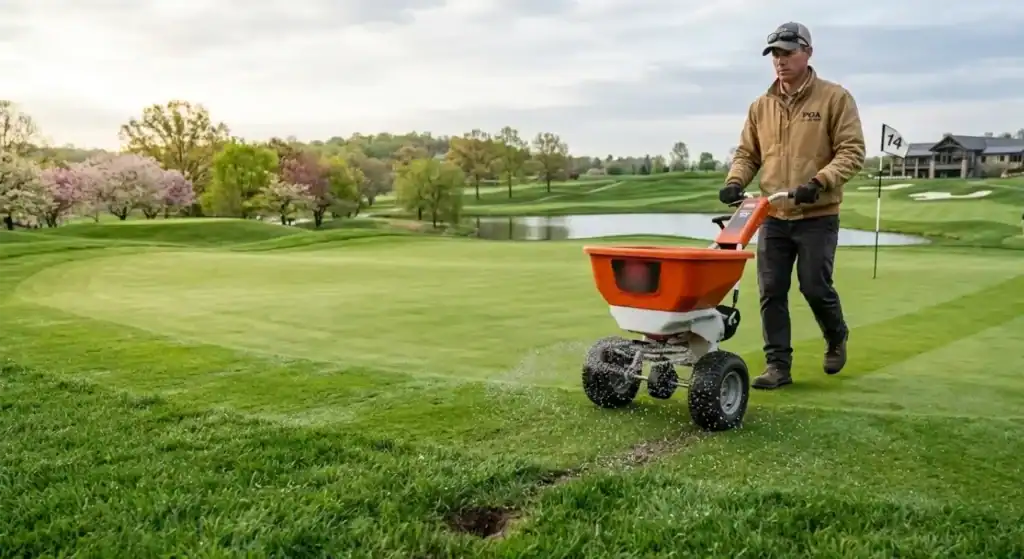
- The Workflow: Track daily average temperatures, calculate the accumulated GDD, and pull the trigger on the spray rig precisely when the model indicates the suppression phase is ending but before the rebound begins.
GDD Calculator
Calculate Growing Degree Days from today's min/max temperature and a base temperature.
You may also like

Read more about GDD and Integrating PGR Primo Maxx
3. Species-Specific Management and Mixed Sward Dynamics
Integrating PGRs becomes an art form when managing the mixed swards common across European greens and fairways.
- Bentgrass vs. Poa annua: If you are trying to transition a green away from Poa annua, a Type B regulator like Paclobutrazol is your scalpel. Because Poa annua absorbs the active ingredient more aggressively than bentgrass, it undergoes severe growth suppression, allowing the bentgrass to physically outcompete it and fill in the voids.
- The Fine Fescue Caution: Fine fescues (Festuca rubra) require significantly lower rates of trinexapac-ethyl compared to bentgrass or ryegrass. Over-regulating fescue can lead to a distinct chlorotic “blue-grey” discolouration and permanently halt recovery from traffic wear. Always calibrate your tank-mix rates to the weakest, or most sensitive, desirable species in the sward.
4. Advanced Tank-Mixing: Fueling the Suppressed Plant
A PGR forces a plant to reallocate its energy, meaning your nutritional program must adjust in tandem. Never spray a PGR on a nutrient-deficient or heavily stressed sward.
- The Nitrogen Balance: To prevent the transient yellowing (bronzing) that can sometimes occur immediately after a PGR application, always pair your regulator with a low dose of readily available nitrogen (such as ammonium sulfate or urea). A typical rate of 0.5 to 1.5 kg of N per hectare is usually enough to maintain pristine color without overriding the growth regulation.
- The Iron Mask: Including chelated iron (Fe) or amino acid complexes in the tank mix acts as a visual safeguard. It stimulates chlorophyll production, ensuring that the denser turf canopy reads as a rich, uniform green.
- Sequential Seedhead Suppression: For early spring management, tank-mixing Ethephon (a Type C regulator that releases ethylene) with trinexapac-ethyl between 400 and 600 GDD (Base 32°F) is the gold standard for blocking Poa annua seedhead flush, preserving both surface smoothness and energy reserves.
5. Managing the Rootzone Environment
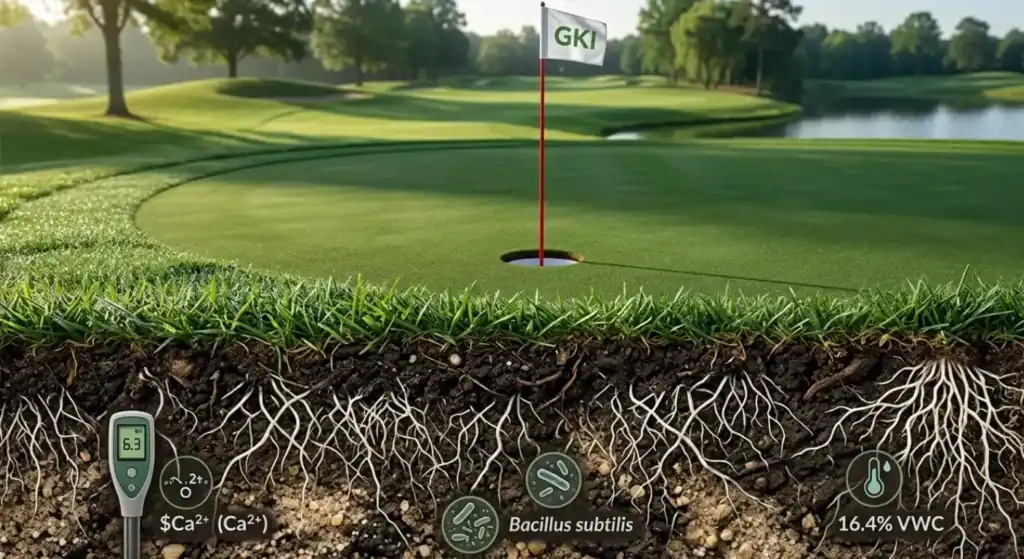
Total rootzone literacy is essential when running an aggressive PGR program. Because PGRs increase root density and encourage lateral tillering, the organic matter profile change accelerates.
- Thatch Monitoring: Increased tillering means more stolon and root turnover. Greenkeepers utilizing high-rate PGR programs must step up their micro-cloning, light topdressing, and verticutting schedules to ensure that organic matter does not accumulate into a soft, spongy thatch layer.
- Moisture Management: A turf canopy regulated by PGRs actually exhibits improved water-use efficiency (WUE) because shorter leaves mean transpirational water loss is reduced. However, because root systems are denser, ensure that your wetting agent program is consistent to avoid localized dry spots (LDS) that could cause uneven uptake of root-absorbed Type B regulators.

Suggested Reading:
Mastering Professional Turf Management: Success Secrets for Elite Surfaces
Integrating PGRs in Your Turf Program: FAQ
What is the main benefit of integrating PGRs into a turf management program?
When integrated properly, Plant Growth Regulators (PGRs) dictate carbohydrate allocation, maximize root development, improve shade tolerance, and significantly boost the stress resilience of your turf.


Why should greenkeepers move away from calendar-based PGR scheduling?
Turf metabolism is driven by temperature, not calendar dates. Applying PGRs based on a fixed schedule can lead to either the “rebound phase,” where the plant experiences a growth surge, or over-regulation, which can cause thinning and severe stunting.
How does the GDD model help in integrating PGRs?
Growing Degree Day (GDD) models allow you to track the accumulated temperature to time applications precisely. This ensures you apply the product when the suppression phase is ending, avoiding both the growth rebound and over-regulation.
What is the difference between Type A and Type B PGRs?
Type A inhibitors (like Trinexapac-ethyl) work late in the gibberellin biosynthesis pathway to inhibit cell elongation, promoting density and lateral growth. Type B inhibitors (like Paclobutrazol) target early-stage synthesis and are primarily root-absorbed, making them effective for shifting the competitive balance in mixed swards, such as suppressing Poa annua.
How can I prevent the “bronzing” effect after a PGR application?
To maintain color and prevent transient yellowing, you should pair your PGR application with a low dose of readily available nitrogen (0.5 to 1.5 kg per hectare) or include chelated iron or amino acid complexes in your tank mix.
Conclusion: Precision Over Force
Integrating PGRs into a modern turf program isn’t about shutting the plant down—it’s about optimizing its internal economy. By shifting from calendar dates to GDD tracking, matching chemistry to botanical composition, and supporting the plant with precise nutrition, greenkeepers can curate surfaces that are not only faster and smoother, but fundamentally healthier from the rootzone up.
In the modern era of greenkeeping, the most successful turf managers aren’t the ones fighting nature with excessive inputs; they are the ones using data to whisper to the plant exactly how to grow.

Head greenkeeper in Gothenburg, Sweden, working in the turf industry since 2018. Passionate about sustainable maintenance and new technologies, he focuses on innovative ways to improve turf quality while reducing environmental impact.
The founder of this independent platform, created to connect turf professionals and enthusiasts, share knowledge, and highlight the evolving role of greenkeepers worldwide.
When not on the course, he enjoys exploring golf destinations, writing about turf management, and engaging with the international greenkeeping community. A big fan of Swedish football — especially the Allsvenskan — and an enthusiastic Football Manager player. Beyond turf and football, a happy father and husband.