
Leadership for head greenkeepers is tested every morning: by changing weather, limited labour, machinery failures, golfer expectations and the condition of the course. Technical knowledge matters, but it does not automatically create clarity, trust or consistent performance. A head greenkeeper or course manager must deliver the work, hold a team together and help individuals improve—often at the same time.
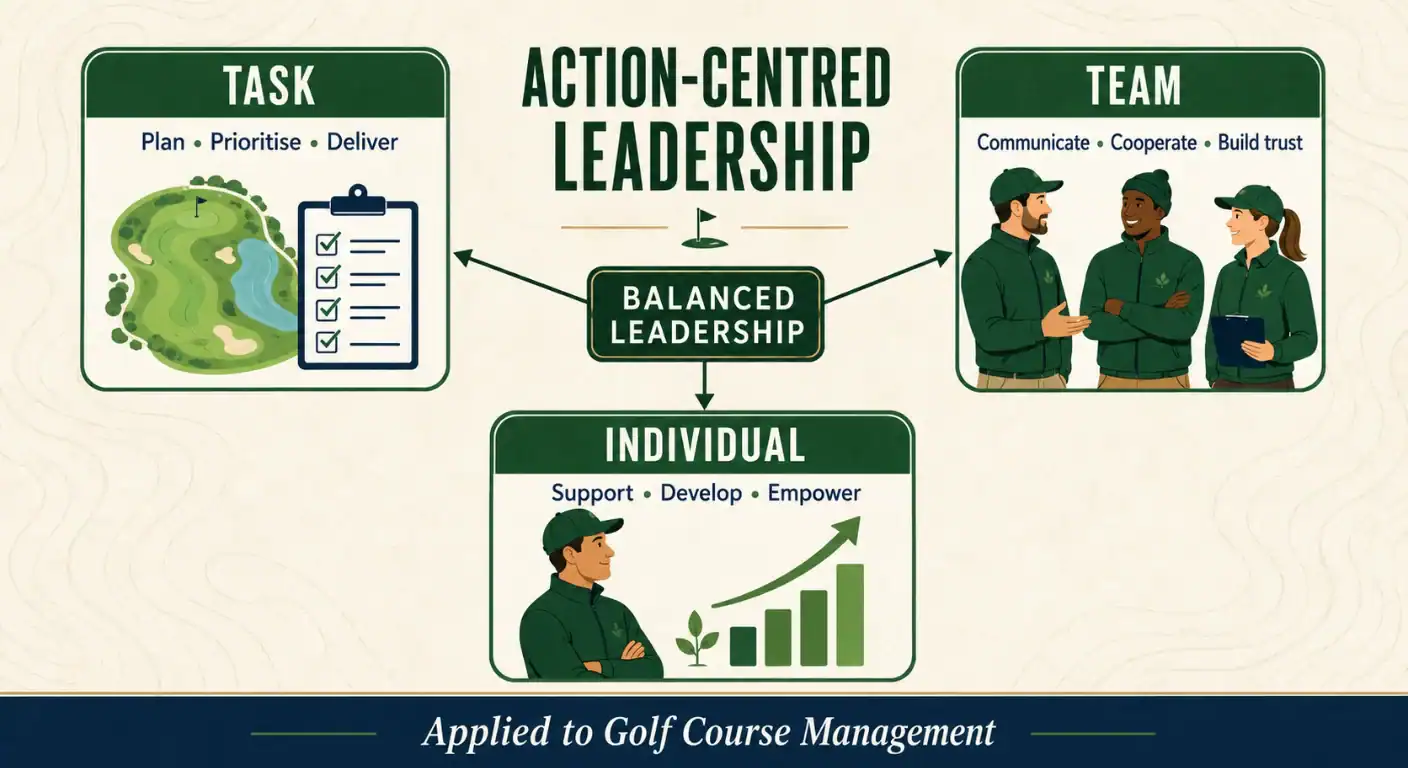
John Adair’s Action-Centred Leadership model gives turf managers a practical way to think about that responsibility. The model describes three connected leadership needs: achieving the task, building and maintaining the team, and developing each individual. None can be treated as optional. A perfectly completed renovation programme is not a leadership success if the team is exhausted and one experienced employee is preparing to leave. Equally, a friendly department is not effective if greens presentation, safety checks and seasonal work repeatedly fall below the agreed standard.
For golf course leaders, leadership for head greenkeepers becomes easier to apply because Adair’s approach is simple. It can be used during a five-minute morning briefing, a difficult performance conversation, an aeration week or a full seasonal review. This guide translates the model into decisions that head greenkeepers and course managers make on real courses.
What is Action-Centred Leadership?
Action-Centred Leadership provides a useful foundation for leadership for head greenkeepers. It was developed by British leadership thinker John Adair. It treats leadership as a set of practical functions rather than a personality trait reserved for naturally charismatic people. BusinessBalls summarises the model through three overlapping areas of responsibility: achieving the task, managing the team and managing individuals. Because the areas overlap, a decision in one area normally affects the other two.
This matters in greenkeeping because course operations are tightly connected. Asking a small crew to hand-water, rake bunkers, mow greens and prepare tournament details may achieve the immediate task, but repeated overload can damage morale and increase mistakes. Giving one employee constant access to skilled machinery may seem efficient, but it can prevent other team members from developing. Reducing standards to avoid a difficult conversation may preserve short-term harmony but weaken the department’s credibility.
In leadership for head greenkeepers, the leader’s job is not to give identical attention to all three areas every minute.. It is to recognise which need is most exposed, act deliberately and restore balance before a weakness becomes a larger operational problem
The three leadership needs on a golf course
- Task: the standard of work that must be achieved—safe and playable surfaces, presentation targets, deadlines, budgets and legal or environmental requirements.
- Team: the shared culture, coordination and confidence that allow the crew to perform together under pressure.
- Individual: the competence, motivation, wellbeing and development needs of each employee
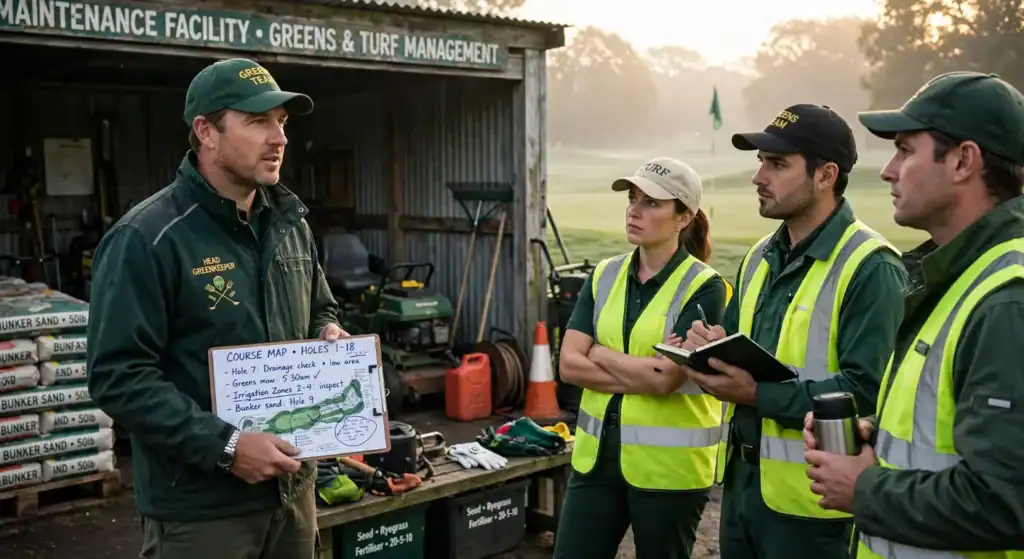
Leadership for head greenkeepers becomes especially visible on a summer morning after heavy rain. Bunkers need repair, greens need inspection, set-up must be completed and the first tee time cannot simply be moved. Task leadership means defining the critical outcome and reallocating labour. Team leadership means explaining the change, keeping communication calm and preventing blame. Individual leadership means noticing that a new employee does not yet know the safe method for repairing a washed-out bunker face and pairing that person with someone experienced.
You may also like

1. Define the task in terms the team can act on
The first lesson in leadership for head greenkeepers is that “make the course look good” is not a useful task. The team needs a clear purpose, priorities, standards, responsibilities and timescale. Adair’s task functions include identifying aims, planning resources, allocating responsibility, monitoring performance and reviewing the plan. That language fits golf course management almost perfectly.
A strong morning brief does more than distribute jobs. It explains what matters most today and why. For example:
“Our priority is firm, consistent putting surfaces before the 08:00 shotgun start. Greens 4 and 11 are holding moisture, so check them before mowing. If either surface marks, stop and call me. Bunkers on the front nine come next; detail work around paths can wait.”
That instruction gives an outcome, risk information, decision limits and an order of priority.
In leadership for head greenkeepers, visible standards should be used wherever possible. Mowing height, clipping yield, moisture targets, green speed, bunker presentation, hole-location procedure and machinery checks should not depend on what a supervisor happens to notice. A written standard reduces ambiguity and makes feedback fairer. It also allows an employee to assess their own work before a manager intervenes.
2. Plan resources before pressure exposes the gaps
Leadership for head greenkeepers requires task leadership that goes beyond demanding that the crew work faster. It includes matching people, machinery, time, materials and information to the required result. On a golf course, weak planning often appears as leadership failure on the day: no trained replacement for the greens mower, missing topdressing material, a sprayer booked for another task, or an irrigation repair started without the correct fittings.
Before a major operation, ask five questions: What result is essential? What could prevent it? Which skills are required? What is the fallback if equipment, weather or staffing changes? What work can be postponed without creating a new risk? This short review is especially useful for renovations, tournaments, spraying windows and autumn leaf work.
Good plans also create decision points. If rainfall exceeds a set amount, if surface moisture remains above a threshold or if the forecast spray window closes, the team should know whether the operation changes, pauses or stops. This is leadership because it gives people the information and authority to protect quality and safety without waiting for the manager at every step.
3. Build a crew, not a collection of job assignments
Leadership for head greenkeepers must account for how fragmented golf course departments can become. One person mows greens, another manages irrigation, another operates the rough mower and seasonal staff complete repetitive presentation work. Specialisation improves efficiency, but it can also create silos, status differences and single points of failure.
Adair’s team responsibility includes agreeing standards of behaviour, developing cooperation, resolving conflict, maintaining communication and creating a shared sense of purpose. For a head greenkeeper, that begins with language. “My greens” or “your bunkers” may sound harmless, but the course result belongs to the department. The irrigation technician’s work affects mowing quality; the mechanic’s priorities affect every operation; the bunker crew influences how golfers judge the entire course.
Create deliberate opportunities for shared ownership. Rotate suitable jobs, ask operators to report observations from their areas and include the crew in short post-operation reviews. Cross-training should not mean placing an unprepared employee on specialist equipment. It means building capability through explanation, supervised practice and clear sign-off.
You may also like
4. Protect team standards when the course is under pressure
Leadership for head greenkeepers is most visible when something goes wrong. A breakdown, missed green, irrigation leak or complaint can quickly produce blame. If the leader responds by shouting or humiliating someone, the immediate mistake may be corrected, but the team learns to hide problems. That damages the information flow on which course management depends.
Accountability and psychological safety are not opposites. A leader can be direct about the standard while remaining respectful about the person. Start with facts: what happened, what should have happened and what effect followed. Then establish the cause. Was the expectation unclear? Was training incomplete? Did the employee ignore a known procedure? Did fatigue, workload or equipment condition contribute? The response should match the cause.
When a known standard was ignored, say so plainly and agree the corrective action. When the system created the error, fix the system. When both contributed, address both. Consistency is essential: if experienced staff receive exceptions that new or seasonal employees do not, the team will notice.
5. Know each individual beyond their job title
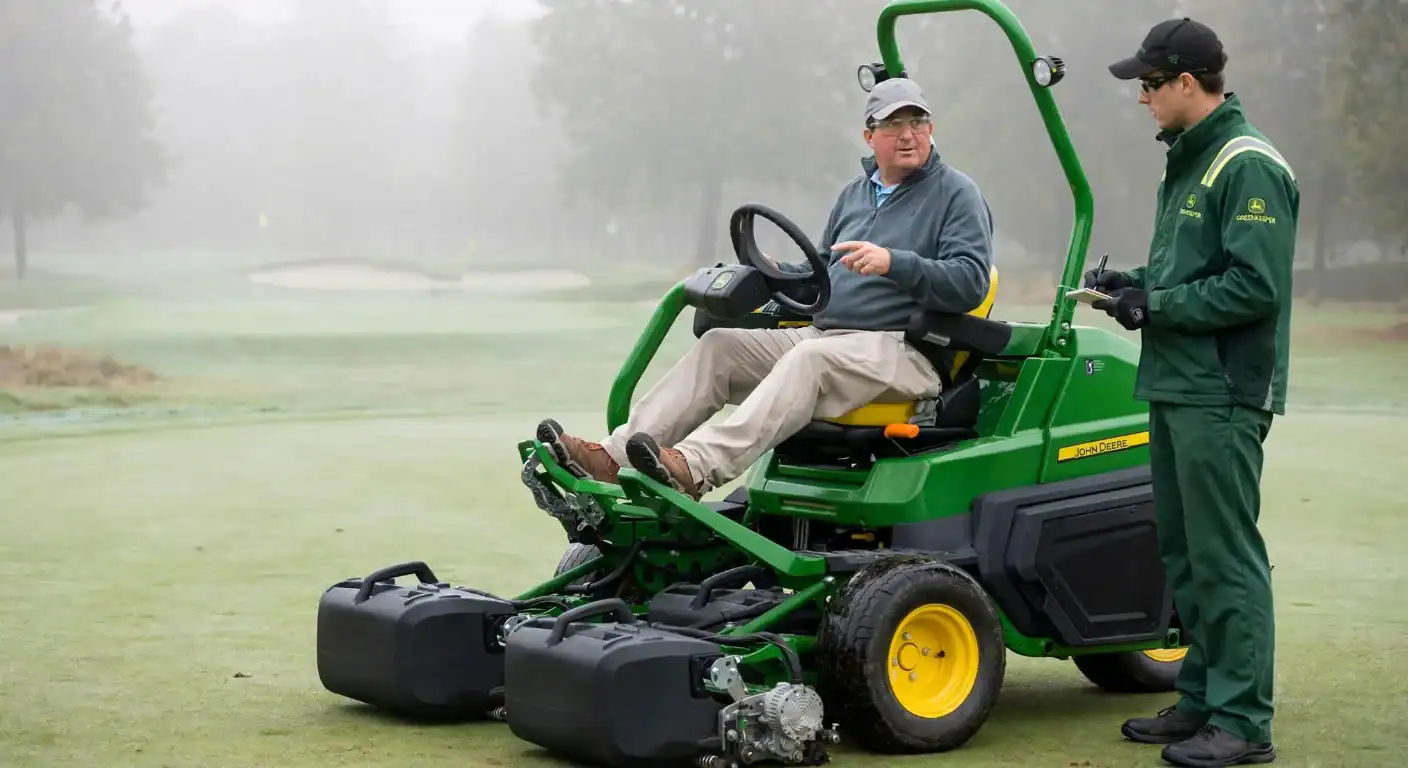
Leadership for head greenkeepers also means using the individual circle to understand each person’s strengths, aims, fears, experience and support needs. Two employees can complete the same task to the same standard but need very different leadership. One may need a new challenge; another may still need reassurance and repeated practice. One may want a career in turf management; another may value predictable seasonal employment and a respectful workplace.
Individual attention does not require lengthy formal meetings every week. Short, specific conversations are often more useful: “How confident are you setting the pedestrian mower?” “Which irrigation faults can you diagnose without help?” “What would you like to learn before the end of the season?” “Is anything making this task harder than it should be?”
Leadership for head greenkeepers also requires simple development notes and consistent follow-up. If a leader repeatedly asks about ambitions but never creates an opportunity, the conversation becomes empty. Development may involve shadowing the mechanic, helping calibrate a sprayer, attending a turf seminar, leading a morning brief or planning a small project. Responsibility should expand with competence, not merely with time served.
6. Delegate outcomes, authority and boundaries
In leadership for head greenkeepers, delegation is one of the clearest places where task, team and individual needs overlap. Done well, it completes work, increases departmental capacity and develops an employee. Done poorly, it becomes either micromanagement or abandonment.
A useful delegation brief contains six elements: the required outcome, the reason it matters, the standard, available resources, decision boundaries and the review point. For example, asking a deputy to “sort the bunkers” is vague. Asking them to inspect washouts, prioritise safety and playability, allocate four staff, postpone edging if necessary and report progress at 09:30 creates real ownership.
The leader must also decide what not to delegate. Legal responsibility, sensitive employment decisions, unapproved chemical applications and risks beyond an employee’s competence remain with the appropriate manager. Delegation transfers authority for defined work; it does not remove the leader’s accountability.
You may also like
7. Use the six leadership functions during daily operations
For leadership for head greenkeepers, six core functions associated with Adair’s approach are especially useful: planning, initiating, controlling, supporting, informing and evaluating. They offer a useful cycle for course operations.
- Planning: gather information, define the outcome, identify constraints and decide priorities.
- Initiating: brief the crew, allocate work, confirm standards and start at the right time.
- Controlling: monitor safety, quality and progress without hovering over every movement.
- Supporting: remove obstacles, encourage effort, reconcile tension and help when pressure rises.
- Informing: share changes, explain decisions, listen to observations and keep stakeholders updated.
- Evaluating: compare the result with the target, identify lessons and adjust the next plan.
Consider a hollow-tining operation. Planning covers weather, machines, tines, sand, staffing, golfer communication and contingencies. Initiating is the pre-start briefing and allocation. Controlling includes depth, spacing, surface disruption and production rate. Supporting means rotating physically demanding roles and helping when a machine blocks. Informing covers updates to the golf shop and team. Evaluating asks whether the agronomic objective, finish and reopening time were achieved—and what should change next time.
8. Adjust leadership for head greenkeepers to the situation
The three needs remain present, but their urgency changes. During an approaching storm, task direction may temporarily become more prominent: secure equipment, protect vulnerable areas and complete critical drainage work. During winter training, individual development may receive more time. After conflict or a demanding tournament week, rebuilding team trust and energy may be the priority.
Situational balance does not mean neglect. A crisis may justify a highly directive approach, but the leader should later explain decisions, review the response and recognise the team’s contribution. A development session may focus on an individual, but the learning should ultimately strengthen team resilience and course performance.
A useful end-of-day question is: Which circle received most of my attention today, and which one now carries the greatest risk? If the answer remains the same for weeks, the department is probably accumulating a hidden cost.
9. Review leadership, not only turf results
Leadership for head greenkeepers benefits from the same discipline used to observe surfaces, measure conditions and adjust programmes. The same discipline can improve leadership. A course may meet presentation targets while the department develops high absence, low trust or overdependence on two key employees. These are leading indicators of future operational weakness.
Review the three areas every week. Under task, consider completion, quality, safety, resource use and stakeholder communication. Under team, consider cooperation, morale, conflict, information sharing and resilience. Under individual, consider workload, competence, feedback, recognition and development. Do not turn this into an elaborate scoring system unless it helps. The purpose is to notice imbalance early and choose the next leadership action.
A practical weekly leadership review for course managers
| Area | Questions to ask | Possible next action |
| Task | Are priorities, standards and deadlines clear? Where are quality or safety drifting? | Clarify one standard; remove one resource bottleneck; reset one priority. |
| Team | Are people cooperating and sharing information? Is conflict being addressed? | Run a short review; recognise shared effort; resolve one recurring friction point. |
| Individual | Who needs feedback, support, training or greater responsibility? | Schedule one conversation; create one supervised learning opportunity. |
Common mistakes in leadership for head greenkeepers
Treating the model as three separate checklists
The circles overlap. Training an employee is not only an individual action; it improves team flexibility and protects future tasks. Clarifying a course standard is not only task management; it reduces conflict and makes feedback fairer.
You may also like

Using “the task” to justify permanent overload
Leadership for head greenkeepers must recognise that seasonal pressure is real, but continuous emergency mode usually signals a planning, staffing, equipment or expectation problem. A leader who repeatedly spends team energy without restoring capacity is borrowing from future performance.
Assuming morale means avoiding difficult conversations
Teams trust leaders who address poor performance fairly. Ignoring a repeated problem shifts work onto reliable employees and damages morale. The conversation should be prompt, private, factual and focused on the required change.
Developing only the strongest or most ambitious employee
High-potential staff deserve opportunities, but resilience requires broader capability. Seasonal and entry-level employees also need clear standards, useful feedback and a path to improve. Development should serve both the person and the department.
Confusing visibility with leadership
Leadership for head greenkeepers requires time away from machinery: constant operational work may earn respect, but it can prevent a head greenkeeper from planning, observing, coaching and communicating. The manager should help operationally when needed while preserving enough time to lead the whole system.
How leadership for head greenkeepers looks in four real situations
Tournament preparation
In tournament preparation, leadership for head greenkeepers starts by defining presentation priorities, timings, quality checks and fallback plans. Team: coordinate split shifts, communication and recovery time. Individual: match high-risk jobs to competence while creating supervised development where the schedule allows.
A machinery breakdown
During a machinery breakdown, leadership for head greenkeepers starts by making the area safe, diagnosing the impact and re-planning work. Team: prevent blame and share the new priorities. Individual: support the operator, establish facts and provide training if the failure involved procedure.
An underperforming employee
With an underperforming employee, leadership for head greenkeepers starts by restating the expected standard and evidencing the gap. Team: protect fairness and workload distribution without discussing confidential details. Individual: identify the cause, agree support and action, set a review date and document appropriately.
A proposed budget reduction
During a proposed budget reduction, leadership for head greenkeepers starts by showing the effect on course standards, risk and work programmes. Team: communicate what is known without creating rumours. Individual: discuss likely role or workload effects honestly, within the information the manager is authorised to share.
A 30-day Action-Centred Leadership plan
- Week 1 — Observe: record where task confusion, team friction and individual dependency appear. Ask the crew what regularly slows good work.
- Week 2 — Clarify: improve the morning brief, write or refresh two important work standards and confirm who owns key decisions.
- Week 3 — Develop: hold short individual conversations and select one practical learning goal for each employee where appropriate.
- Week 4 — Review: ask what improved, what remains fragile and which leadership circle needs deliberate attention next month.
Keep this 30-day leadership for head greenkeepers plan small enough to complete. Leadership improves through repeated behaviour: clearer briefs, earlier feedback, better questions, fairer standards and deliberate development. A complicated leadership programme that disappears during the growing season is less valuable than a simple model used every day.
Frequently asked questions
What is the best leadership style for a head greenkeeper?
No single behaviour defines effective leadership for head greenkeepers in every situation. Action-Centred Leadership is useful because it focuses on the needs of the task, team and individual. A head greenkeeper may need to be directive during a safety incident, consultative when improving a workflow and coaching-oriented when developing an employee.

What is the difference between a head greenkeeper and a course manager?
Titles vary between clubs and countries. Both roles can carry responsibility for course standards, staff, budgets, planning and communication, although a course manager may have broader strategic or departmental authority. Leadership for head greenkeepers, course managers and deputies follows the same principles described in this article.
Can Action-Centred Leadership work with a small greenkeeping team?
Yes. Leadership for head greenkeepers in a small crew may benefit even more from the model because one absence, conflict or skills gap has an immediate operational effect. The process does not require formal bureaucracy; it can guide a short briefing, work allocation and a five-minute review.
How can a course manager improve team morale?
In leadership for head greenkeepers, morale is influenced by achievable plans, fair treatment, clear communication, recognition, suitable resources and confidence that problems will be addressed. Social activities can help, but they cannot compensate for unclear expectations, repeated overload or inconsistent leadership.
How often should a head greenkeeper give feedback?
Leadership for head greenkeepers depends on timely, useful feedback. Reinforce good work when it happens and address significant gaps promptly and privately. Formal reviews remain useful for broader development and documented objectives, but they should not be the first time an employee hears about performance.
Conclusion: balance course performance with people performance
Leadership for head greenkeepers is not separate from agronomy or daily operations. It is the process that turns knowledge, labour, machinery and time into consistent course outcomes. John Adair’s Action-Centred Leadership model gives course managers a memorable test: are we achieving the task, strengthening the team and developing the individual?
The balance will move with the season and the situation, but none of the three needs disappears. The best course leaders define standards clearly, plan resources honestly, build cooperation, address problems fairly and give people room to grow. When those habits reinforce one another, better turf performance becomes more sustainable—and the department becomes a place where skilled people want to stay.
What is the biggest leadership challenge in your greenkeeping department today: achieving the task, building the team or developing individuals? Share your experience with the Greenkeeping Insight community.

Head greenkeeper in Gothenburg, Sweden, working in the turf industry since 2018. Passionate about sustainable maintenance and new technologies, he focuses on innovative ways to improve turf quality while reducing environmental impact.
The founder of this independent platform, created to connect turf professionals and enthusiasts, share knowledge, and highlight the evolving role of greenkeepers worldwide.
When not on the course, he enjoys exploring golf destinations, writing about turf management, and engaging with the international greenkeeping community. A big fan of Swedish football — especially the Allsvenskan — and an enthusiastic Football Manager player. Beyond turf and football, a happy father and husband.