

We all love a good underdog story: the person who outworks talent, the team that refuses to quit, the Turf Manager who quietly turns a struggling golf course into a regional masterpiece. Angela Duckworth’s concept of grit “passion and perseverance for long-term goals” captured that intuition and pushed it into the mainstream.
The science is clear on something that often gets overlooked: grit doesn’t work in isolation. To sustain perseverance, you need habits, the automatic routines that make effort repeatable, sustainable, and ultimately effective.
This article integrates what research tells us about grit and what behavioural science teaches us about the habits that make grit possible in the first place.
What is Grit?
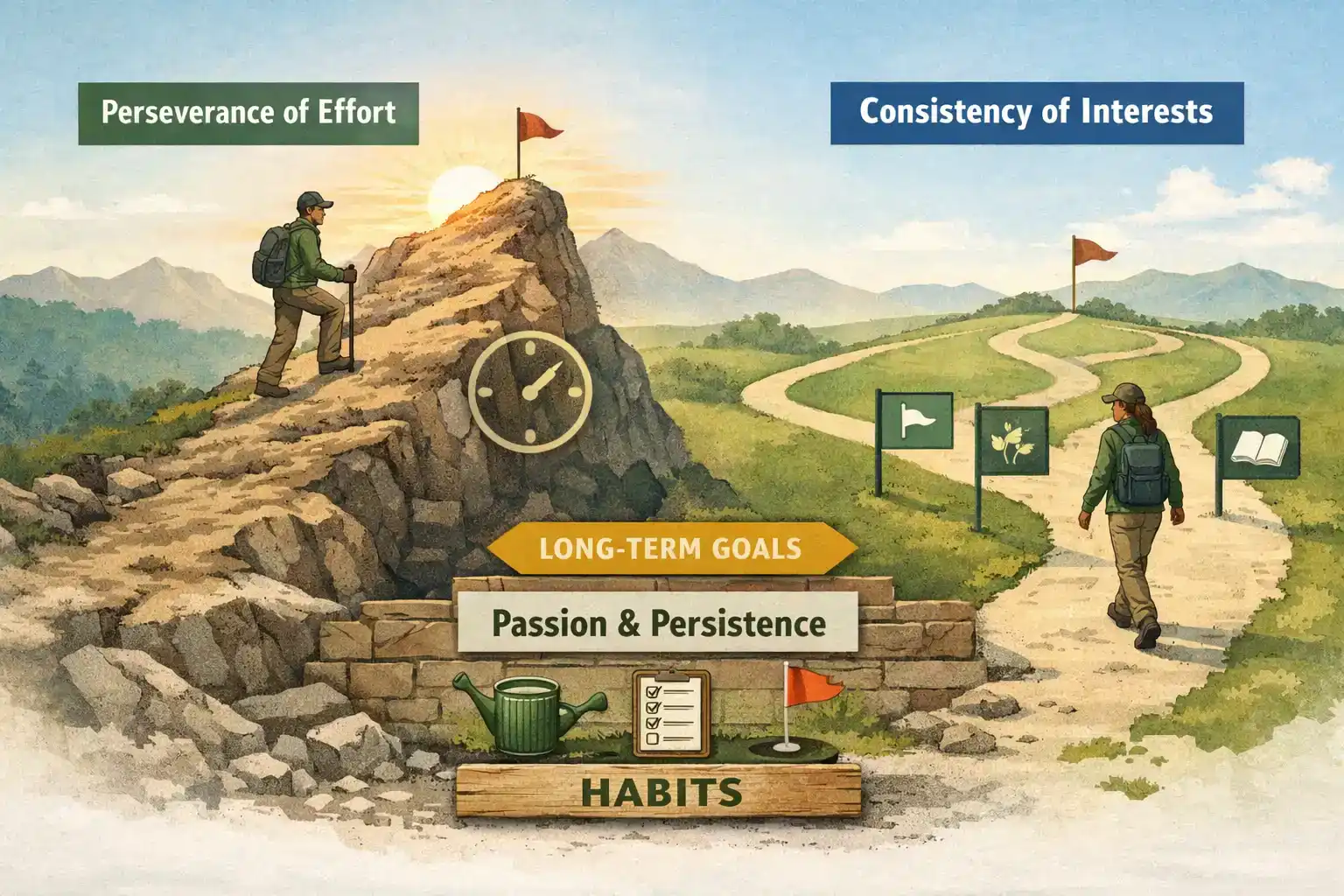
Duckworth and colleagues describe grit as two distinct components:
- Perseverance of effort — sustained effort toward long-term goals.
- Consistency of interests — sticking with the same overarching passions instead of frequently switching direction.
Early studies using self-report scales showed modest but meaningful associations between grit and outcomes such as retention and educational achievement. However, effort alone is not a strategy, this is where habits become the structural foundation that supports perseverance.
Measurement: the Short Grit Scale (Grit-S)
Researchers typically use the ‘Grit-S’, this is a short, validated scale that measures the two components above. It’s useful, but like all self-report tools it captures perceived tendencies, not daily behaviours. This is an important note, because while grit is the trait, habits are the observable behaviours that make grit visible in the real world. You can’t “grit” your way through a season without systems. Habits are those systems.
What grit predicts (and what it doesn’t)
Empirical studies show:
- The perseverance component predicts retention in demanding environments such as military training, sales, and education, even when accounting for intelligence.
- The consistency component adds relatively little predictive value. Meta-analytic research even shows grit overlaps substantially with conscientiousness. And here’s the connection: The outcomes attributed to grit look remarkably similar to the outcomes attributed to strong, stable habits.
Grit may be the intention; habits are the execution.
Overemphasising grit risks ignoring the structural factors that enable or constrain perseverance such as resources, stress exposure, training quality, staffing, equipment, and wellbeing.
Habits again provide a healthier framing, rather than telling people to “be grittier,” Turf Managers can build systems that make desired behaviours automatic, supported, and sustainable.
Why habits are grit’s indispensable partner?
Grit helps you persist whilst Habits help you persist without burning out. Research on habit
formation consistently shows:
- Habits reduce cognitive load.
- Habits maintain behaviour during low-motivation periods.
- Habits create identity consistency (“this is the kind of person/team we are”).
In high-variability professions like greenkeeping, habits become the stabilising force that
enables grit to function.
Grit without habits = burnout.
Habits without grit = directionless routine.
Together = sustainable performance.
Practical actions for Turf Managers
- Measure smartly
If using the Grit-S, report the two components separately. Expect perseverance to link most strongly to actual behaviour. But remember that habit audits may reveal more actionable insights than grit scores alone. - Build contexts that make grit possible
Grit predicts retention, but retention comes from environments that make perseverance practical, high-quality training, good tools, psychological safety, and manageable loads.
Habits are easier to form in stable, well-designed contexts. - Break long-term goals into micro-habits
Breaking long-term goals into micro-habits creates a sustainable pathway to improvement by anchoring progress in small, consistent actions. Daily morning surface checks, weekly moisture audits, routine reflection cycles, and small data-driven adjustments form a recurring loop of feedback and refinement. Over time, these micro-habits strengthen professional identity, build consistency, and reinforce perseverance and turn incremental actions (marginal gains) into a meaningful, long-term transformation. - Watch for selection bias
If you reward only those who display “grit,” you may inadvertently reward privilege. Instead, design habit-supporting systems so that persistence is accessible to everyone. - Measure outcomes, not traits alone
Track retention, performance metrics, learning progression, and operational consistency alongside grit scores. Habits will often explain these outcomes just as well, if not better.
Conclusion:
Grit reflects something undeniably powerful: the willingness to keep investing in long-term goals even when progress feels slow or difficult. While grit fuels the intention, habits are what make that intention sustainable. They convert perseverance into predictable, repeatable action.
You may also like

The science is clear:
Perseverance matters, it keeps people moving toward meaningful objectives. Small, consistent habits matter even more, they create the structure that allows perseverance to endure.
For greenkeeping teams, real leadership isn’t about pushing individuals to “be grittier.” It’s about building environments rich in healthy, reliable habits, where daily actions align with long-term goals, and where perseverance becomes not just possible, but natural, meaningful, and rewarded.
Key references (selected)
- Duckworth, A. L., Peterson, C., Matthews, M. D., & Kelly, D. R. (2007). Grit: Perseverance and passion for long-term goals. Journal of Personality and Social Psychology.
- Duckworth, A. L., & Quinn, P. D. (2009). Development and validation of the Short Grit Scale (Grit-S). Journal of Personality Assessment.
- Eskreis-Winkler, L., Shulman, E. P., Beal, S. A., & Duckworth, A. L. (2014). The grit effect: Predicting retention in the military, the workplace, school and marriage. Frontiers in Psychology.
- Credé, M., Tynan, M. C., & Harms, P. D. (2017). Much ado about grit: A meta-analytic synthesis of the grit literature. Psychological Bulletin.
- The New Yorker. (2016). The Limits of “Grit.” (A critical perspective on policy and equity implications.)

Alongside his course management work, Ben has built a growing international speaking career, delivering talks and workshops to golf course professionals, industry leaders, and organisations. His speaking is known for blending evidence-based science, real-world case studies, and compelling storytelling.
Ben’s work is driven by a belief that excellence is not achieved through shortcuts, but through curiosity, humility, and a commitment to continual learning. Whether managing a golf course or speaking on an international stage, his goal is the same: to help people and organisations perform better by thinking more clearly, acting more intentionally, and respecting the systems they depend on.