
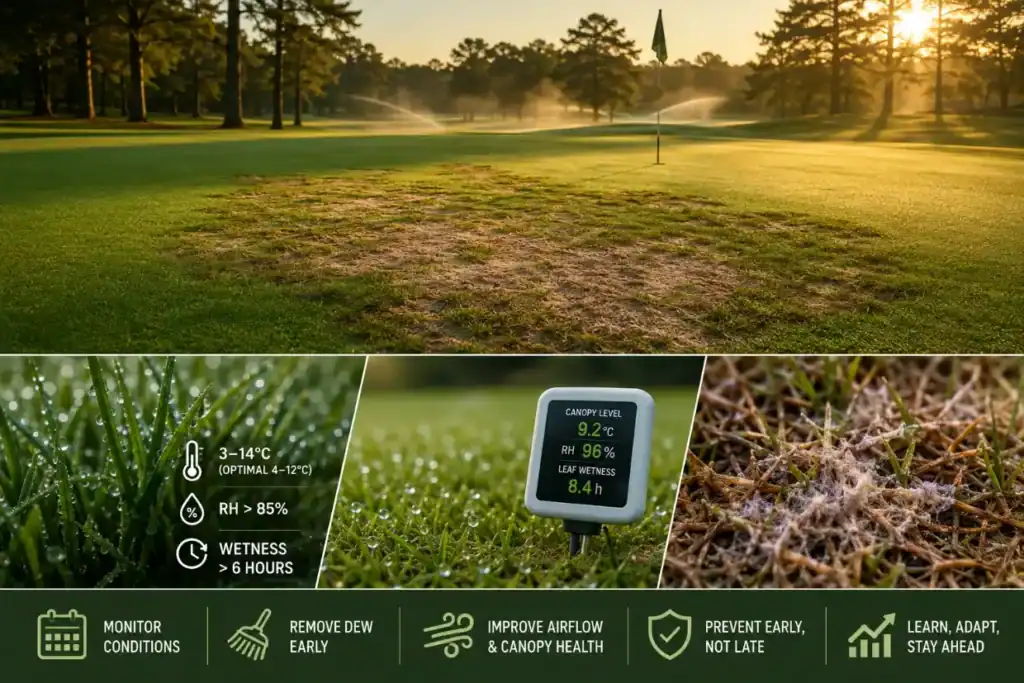

Ask any greenkeeper who worked through late August 2025 how the season went, and you’ll probably get the same reaction: a slow exhale and a shake of the head. Across parts of northern Europe, Microdochium patch seemed to appear almost overnight, turning healthy-looking greens into a scarred mess within days.
The frustrating part? It wasn’t really sudden at all. The conditions had been building for over a week — greenkeepers just couldn’t see them.
This article breaks down what actually happened last summer, why the outbreak caught so many well-run courses off guard, and — more importantly — how to spot the same warning signs early enough to act before symptoms ever show up on the surface.
Much of the underlying weather and disease-pressure analysis referenced here draws on regional turf advisory research published by Syngenta Turf & Landscape, whose Nordic agronomy team has been tracking the 2025 outbreak in detail.
What Actually Happened in Late Summer 2025
Between mid-August and early September 2025, large parts of Scandinavia — and southern Finland too — experienced roughly ten to fourteen days of weather that was quietly ideal for Microdochium nivale, the fungus behind Microdochium patch. On paper, regional forecasts didn’t look especially alarming. In reality, conditions at canopy level were far more favourable for disease than anyone realised at the time.
By the time visible scarring showed up in early September, the Microdochium patch damage had already been developing for over a week. Course managers weren’t dealing with a new problem — they were dealing with an old one that had finally surfaced.
Why the Outbreak Felt So Sudden
Here’s the part that trips up even experienced turf managers: Microdochium nivale has an incubation period of five to ten days. That means the patches you see on a Tuesday morning were likely triggered by conditions from the previous weekend, or even earlier.
If you’re only reacting once symptoms appear, you’re not managing the current Microdochium patch outbreak — you’re managing one that started well over a week ago, with a whole new infection cycle possibly already underway.
The Microdochium “Sweet Spot” Explained
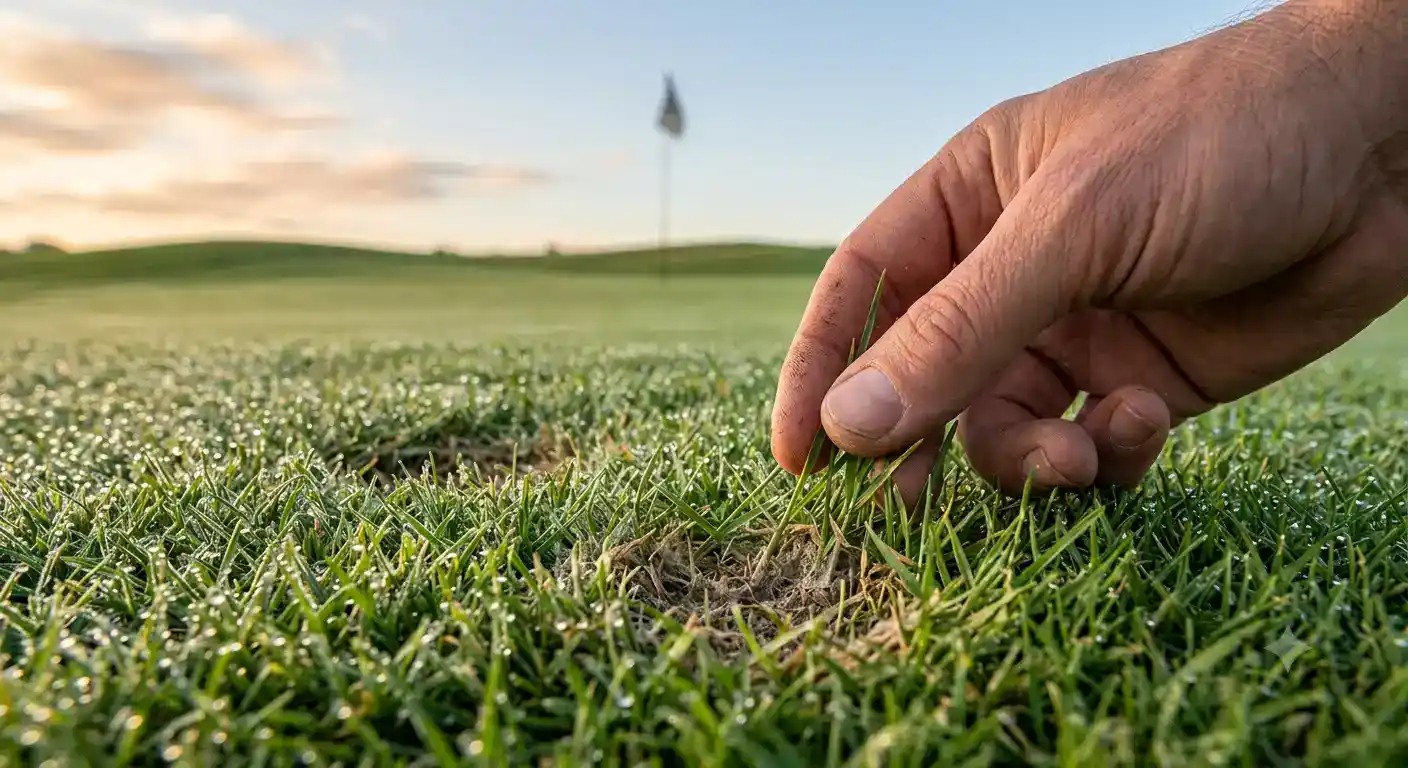
Microdochium patch develops fastest when three conditions line up at the same time:
- Night temperatures between 3–14°C, with 4–12°C being the most favourable range
- Relative humidity sitting above 85% for extended stretches
- Leaf wetness lasting more than six hours a day
Individually, none of these numbers looks dramatic. Together, for several nights in a row, they create exactly the environment Microdochium patch needs to establish and spread.
Forecast vs. Reality: Why Ground-Level Conditions Lie
This is arguably the single most important lesson from 2025: standard weather forecasts are not measuring your greens.
Most forecast data comes from regional models averaged across large grid areas — often around 10 km² — with sensors mounted roughly two metres above open ground. Your putting surface is a completely different microclimate.
Temperature. On clear, calm nights, radiative cooling means the turf canopy can be noticeably colder than the air two metres up. A forecast showing 14°C at head height might mean conditions several degrees cooler right at the leaf surface — squarely inside the disease-favourable range.
You may also like

Humidity. Once dew forms, the air within a dense canopy can sit at close to 100% humidity, even while a weather app reports 75%. A tight turf stand traps that moisture and holds it long after sunrise.
The practical effect during 2025: canopy conditions in affected areas likely reached disease-favourable levels four to six hours earlier each night than regional data suggested.
The Silent Incubation Period
Looking back at the 2025 timeline makes the pattern clear, and it’s a useful template for spotting the next Microdochium patch outbreak before it happens.
Phase one — the build-up (roughly a week before symptoms). Night temperatures dip into the favourable range, paired with persistent dew or leaf wetness. Nothing is visible yet.
Phase two — pressure rises (days before symptoms). Humidity climbs, temperatures stay in range, and dew falls earlier and lingers longer. Infection conditions are close to ideal, but the turf still looks completely normal.
Phase three — the “sudden” outbreak. Visible symptoms appear rapidly, but they’re the product of infections that started five to ten days earlier — not new activity.
The takeaway is simple, if uncomfortable: waiting to see symptoms means you’re already ten days behind the disease.
5 Lessons for Managing Microdochium Patch Proactively
1. Shrink the leaf-wetness window with agronomic practice
You can’t control the temperature, but you can control how long turf stays wet — and that’s exactly where Microdochium patch gets its opening.
- Remove dew early. Clearing dew first thing in the morning can cut the wet-leaf window by four to six hours. If staffing allows, prioritise the most disease-prone greens first rather than working through them in the same order every day.
- Rethink irrigation timing. Avoid schedules that extend surface moisture into the cool early-morning hours.
- Manage canopy density. Regular verticutting and light grooming keep airflow moving through the sward.
- Address shade and airflow. Areas with poor air movement or heavy shade are consistently the first to show symptoms — tree management is a disease-prevention tool, not just an aesthetic one.
2. Stop trusting the forecast at face value
Build a simple mental adjustment into your daily weather check:
- Subtract 2–4°C from the forecast night-time low to estimate canopy temperature.
- Add roughly 10% to forecast humidity to estimate conditions at grass level.
- Track the 10-day trend, not just tomorrow’s number — watch for sustained stretches of humidity above 75% combined with temperatures below 14°C.
3. Use your weakest greens as an early-warning system
Every course has a green or two that historically shows Microdochium patch first — usually due to shade, poor drainage, or airflow issues. Treat these as sentinel sites. Any sign of activity there is a strong signal that the rest of the course is at risk too.
4. Shift from curative to preventive protection
Waiting for the first visible Microdochium patch symptom before treating is rarely the best outcome for turf quality. The more reliable approach is triggering preventive applications based on weather conditions, not visual damage.
If a 7–10 day forecast trends toward cooler nights and persistent dew, that’s your window to act — before symptoms, not after.
You may also like


5. Prove the strategy to yourself with an untreated check plot
Preventive fungicide programmes can feel counterintuitive when there’s no visible disease to justify them. A practical way to build confidence in the approach: leave a small, low-profile area untreated as a control. If disease shows up there while the rest of the green stays clean, it validates that the preventive programme — not luck — is doing the work.
FAQ: Microdochium Patch Management
What temperature range is most favourable for Microdochium patch?
Night temperatures between 3–14°C, with 4–12°C being optimal, combined with humidity above 85% and leaf wetness lasting more than six hours.
Why do Microdochium outbreaks seem to appear overnight?
Because the pathogen has an incubation period of five to ten days. Visible symptoms are the result of infections that began well over a week earlier, not new activity.
Why don’t standard weather forecasts predict disease pressure accurately?
Forecasts average conditions across large grid areas using sensors positioned around two metres above ground. Turf canopy microclimates are typically cooler and more humid than these readings suggest, especially overnight.
Is preventive treatment better than curative treatment for Microdochium patch?
Most turf managers find that weather-triggered preventive programmes protect playing surface quality and texture more reliably than treating after symptoms appear, since visible damage already reflects an infection that’s days old.

Head greenkeeper in Gothenburg, Sweden, working in the turf industry since 2018. Passionate about sustainable maintenance and new technologies, he focuses on innovative ways to improve turf quality while reducing environmental impact.
The founder of this independent platform, created to connect turf professionals and enthusiasts, share knowledge, and highlight the evolving role of greenkeepers worldwide.
When not on the course, he enjoys exploring golf destinations, writing about turf management, and engaging with the international greenkeeping community. A big fan of Swedish football — especially the Allsvenskan — and an enthusiastic Football Manager player. Beyond turf and football, a happy father and husband.