
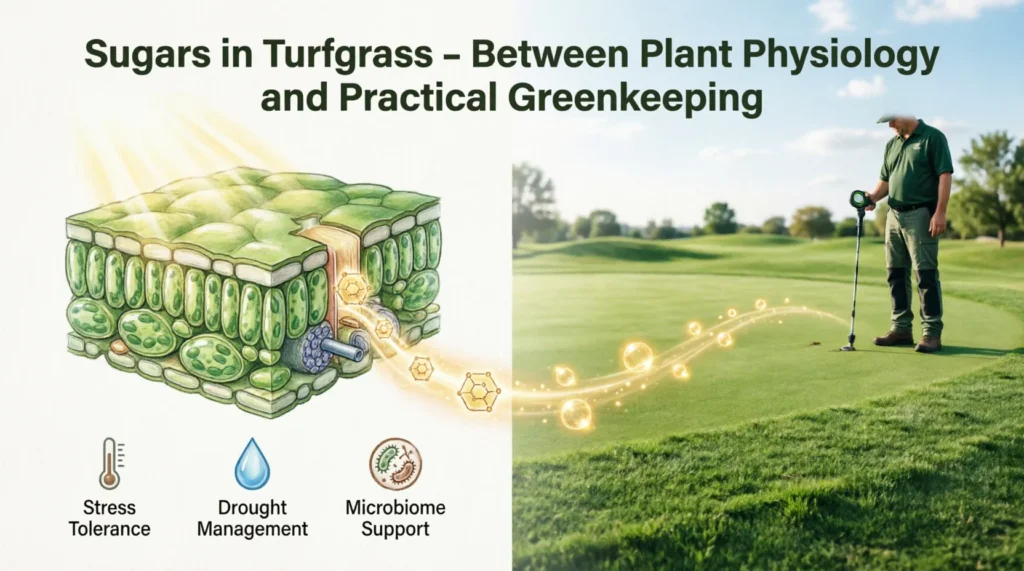
In greenkeeping, many decisions are shaped by experience, observation, and knowledge passed through the industry over years. One such topic is sugars in turfgrass – often discussed in relation to turf quality, stress tolerance, and even pest pressure.
For a long time, I also followed commonly accepted assumptions:
- that sugar stiffens the grass leaf,
- that it increases green speed,
- that it can directly affect insects.
Only after taking a deeper look into the subject – including practical use of products such as MolTurf (Angus Horticulture) – did I realise how much of this thinking is based on simplifications rather than actual plant physiology.
I was no exception. I believed many of these ideas myself. That is exactly why I decided to explore the topic further and understand how much truth there really is behind them.This article is an attempt to separate facts from myths, from the perspective of a practicing course manager.
1. Sugars in Turfgrass– the foundation of plant function
Sugars (soluble carbohydrates and storage forms such as fructans) are the primary energy source for plants. They are produced through photosynthesis and used for:
- growth and regeneration,
- tissue development,
- root system function,
- stress response.
From a practical perspective, one principle stands out:
plant performance is directly linked to its energy balance.
When production exceeds consumption, the plant builds reserves.
When consumption exceeds production, the plant begins to decline.
2. Sugars and stress tolerance
One of the most well-documented roles of sugars is their contribution to stress resistance, particularly under low temperature conditions.

Sugars:
- lower the freezing point of cellular water,
- stabilise cell membranes,
- reduce damage caused by ice formation.
In turfgrass management, this translates into:
- improved winter hardiness,
- reduced frost damage,
- faster spring recovery.
Similar mechanisms apply under:
- drought stress,
- heat stress,
- intensive wear.
3. Shade – managing an energy deficit
Shaded areas represent one of the biggest challenges in turf management.
Under low light conditions:
- photosynthesis is reduced,
- sugar production declines,
- the plant relies on stored reserves.
In this situation, the key is not simply feeding the plant, but managing energy consumption.
In practice, this means:
- reducing nitrogen inputs,
- minimising stress,
- increasing mowing height,
- improving light conditions where possible.
Managing shade is, in reality, managing an energy deficit within the plant.
4. Sugars and surface performance – facts vs interpretation
It is often suggested in the industry that higher sugar levels directly lead to:
- stiffer leaf blades,
- improved mowing quality,
- faster green speeds.
The reality is more nuanced.
A plant with a strong energy status:
- tolerates low mowing better,
- recovers faster,
- maintains a more uniform sward.
This leads to:
- cleaner cuts,
- reduced leaf shredding,
- improved surface consistency.
The effect on green speed is therefore indirect, not direct.
It is also important to note that leaf stiffness is primarily influenced by:
- cell wall structure,
- lignin content,
- silica,
rather than sugar concentration itself.
5. Sugars and insects – addressing a common myth
A frequently repeated theory suggests that sugars consumed by insects ferment into alcohol within their bodies, ultimately leading to their death.
There is no scientific evidence supporting this mechanism.
You may also like


Insects:
- are capable of metabolising sugars efficiently,
- often thrive in fermenting environments,
- are adapted to the presence of alcohol in natural ecosystems.
However, it is true that:
- increased sugar availability influences soil microbiology, which in turn can affect the broader ecosystem, including soil-dwelling organisms.
6. MolTurf and the role of carbon in soil systems
Products such as MolTurf (Angus Horticulture) are often perceived as a way of “feeding sugar directly to the plant.”
In reality, their primary function is different.
They act as:
- a carbon source for soil microorganisms,
- a stimulant for biological activity,
- a driver of nutrient cycling.
The result is:
- a more active soil environment,
- improved nutrient availability,
- greater system stability.
It is important to emphasise:
MolTurf does not replace photosynthesis and does not directly supply energy to the plant.
It supports the system, rather than acting as a direct energy input.
7. Should we measure sugars in turfgrass?
There are methods available, including:
- Brix measurements (field-based),
- laboratory analysis (WSC, fructans).
However, in practical turf management:
- results are highly variable (time of day, environmental conditions),
- there are no clear threshold values,
- interpretation is complex.
As a result, sugar measurements are best used:
- as a diagnostic tool,
- in research or trial work,
- in extreme or specific conditions.
They rarely serve as a primary decision-making tool in day-to-day management.
8. What really controls sugar levels in plants
From a management perspective, the key factors are:
- light availability,
- nitrogen levels,
- water management,
- stress intensity,
- usage pressure.
These determine:
- how much sugar the plant produces,
- how much it consumes,
- how much it can store.
9. A shift in approach
The most important lesson for me was a change in mindset.
From:
“apply a product to create an effect”
To:
“build a system that performs consistently”
Products like MolTurf have a place in modern turf management, particularly in:
- soil biology,
- reducing chemical inputs,
- developing resilient systems.
But their effectiveness depends entirely on the broader management approach.
Conclusion
Sugars in turfgrass:
- are fundamental to energy and performance,
- play a key role in stress tolerance,
- indirectly influence turf quality.
However:
- they are not a direct tool for increasing green speed,
- they do not determine leaf stiffness,
- they do not directly control insect populations.
The key takeaway about sugars in turfgrass is simple:
We do not manage sugars by applying sugar –
we manage them by controlling the environment in which the plant operates.