


The putting green is arguably the most critical area on any golf course. When a course features pristine, high-performing greens, golfers are far more likely to overlook minor shortcomings in other areas. In the world of professional turfgrass management, superintendents know a simple truth: if your greens are smooth, true, and healthy, golfers will easily overlook minor imperfections on the fairways or bunkers. Being trusted with mowing golf greens signifies that you have gained the necessary knowledge and trust required for professional turfgrass management. Because greens typically require daily mowing, mastering the nuances of the cut is vital. Below are 10 essential greenkeeping tips to elevate your technique and achieve an absolute premium quality of cut.
Being trusted to handle the daily maintenance of these surfaces is a major milestone for any greenkeeper. Mowing golf greens requires a sharp eye, steady hands, and an understanding of how mechanical adjustments impact living plants. Whether you are training a new crew member or looking to refine your own course setup routine, following these ten fundamental steps will elevate your technique from basic maintenance to true greenkeeping artistry.
1. Ensure Sharp Mower Units
While sharpening the reel blades is typically the responsibility of the equipment technician, every operator must be able to recognize whether a unit is sharp or dull. Reels must be cleaned thoroughly after every use. To check the sharpness safely, perform a paper test : insert a piece of paper between the reel blade and the bedknife, and rotate the reel manually. When mowing golf greens, using a dull blade will tear the grass rather than slice it, which is why checking reel sharpness daily with a paper test is absolutely vital.
CRITICAL SAFETY REMINDER: Never attempt this check while the engine is running!
2. Choosing the Right Mower: Single Flex vs. Triplex Mowers
The choice between walk-behind (single flex) mowers and riding triplex mowers depends on the course architecture, budget, and the superintendent’s maintenance philosophy. Greenkeeping strategies and maintenance budgets usually dictate whether a crew utilizes a walk-behind single flex mower or a riding triplex mower. The choice goes far beyond simple operator comfort; it directly impacts soil health, daily labor hours, and the visual quality of the final cut.
Elite, high-budget facilities and championship golf courses heavily favor walk-behind single flex mowers. Because these units are significantly lighter than ride-on equipment, they dramatically reduce the risk of heavy mechanical soil compaction and tracking along the delicate edges of the green. Furthermore, walk-behind mowers allow the operator to follow the organic contours of the turf precisely, producing incredibly crisp, traditional striping patterns that look spectacular on television broadcasts and tournament days. However, operating a single flex mower requires immense physical stamina, a highly practiced, consistent walking stride, and a larger crew to get the course ready before the morning’s first tee time.
Conversely, riding triplex mowers are the powerhouses of daily course maintenance, especially for facilities with larger greens or smaller crews. Equipped with three synchronized cutting units, a triplex mower covers massive surface areas in a fraction of the time, saving valuable labor hours that can be redirected to other detailed projects on the course. While modern triplex units feature advanced weight distribution and steering mechanisms to minimize turf wear, they do require a skilled operator who understands how to manage turnarounds properly to prevent triplex ring—a common wear pattern caused by repeated tires rolling over the exact same perimeter path day after day.
You may also like

3. Clear Debris and Inspect the Turf
Rushing onto a green without checking the surface is a critical error. Small sticks, stones, or pine cones hidden in the turf can instantly chip the bedknife or damage the reel. Striking debris can leave long, unsightly gouges or scratches across the putting surface that take weeks to heal. Take a moment to scan the surface prior to firing up the reels. A critical prerequisite to safely mowing golf greens is walking the surface to remove sticks and stones that could instantly damage your cutting reels.
4. Manage the Morning Dew
Depending on seasonal changes, morning dew can be heavy, particularly during warm days paired with cold nights in the spring and autumn. Excess moisture is highly detrimental to thin grass leaves, dulls mower knives rapidly, and creates a breeding ground for fungal turf diseases. Removing dew before cutting protects both the turf health and your equipment.
5. Remove the Pin Flag Before Mowing
While some seasoned operators attempt to grab the flagstick on the fly while riding a triplex mower to save time, this practice often results in crooked lines or accidental turf damage. The best practice is to walk onto the green, remove the flag completely, and place it safely aside. This stroll also provides an excellent opportunity to scan the surface for debris, disease indicators, or un-repaired pitch marks.
6. Master the Crucial First Stripe
The first pass sets the trajectory for the entire green. Establishing a laser-straight initial pass sets the visual baseline for the entire surface, making horizon tracking an essential skill when mowing golf greens. Because every subsequent pass relies on the border of the previous one, an unaligned first pass will ruin the layout. To ensure a perfectly straight line, choose a fixed point on the distant horizon—such as a tree, a stone, or a bench—and focus directly on it as you guide the mower across the green.
7. Maintain a Proper Overlap
Leaving narrow, uncut strips of grass due to an insufficient overlap is a cardinal sin in professional greenkeeping. Uncut strips cause golf balls to bounce and deviate from their true line, frustrating players. Novice operators should intentionally overlap a bit more until they develop consistency. Use the visual markings on the mower’s grass catcher basket to help maintain a stable, uniform line.
Missing a small strip of grass becuse of insufficient overlap is a cardinal sin against good greenkeeping.
Practical Golf Course Maintenance: The Magic of Greenkeeping Michael Bavier, Gordon Witteveen
Eliminating missed strips of grass requires consistent concentration, as leaving “mohawks” while mowing golf greens will directly ruin the golfer’s ball roll.
8. Execute a Clean Cleanup Lap
The final perimeter pass around the outer edge of the green is known as the “clean lap” or cleanup pass. This step requires complete focus. Veering too far outward into the collar or apron will scalp the taller turf, causing an ugly brown streak. Conversely, under-cutting leaves an inconsistent edge. Slow the mower down to a crawl and use the outer guide marks on the basket to follow the exact perimeter. Taking your time and slowing down during this final perimeter pass is the only way to avoid costly mistakes when mowing golf greens.
You may also like


9. Never Stop in the Middle with Running Reels
If you must bring the mower to a stop for any reason, always disengage the cutting reels first. Stopping a mower while the blades are actively spinning creates an instant friction burn on the turf. This leaves an unsightly yellow scar, weakens the grass plants, and invites localized disease. Keep the machine moving smoothly until the reels are safely turned off. Always remember to shut off the cutting units before bringing the machine to a complete halt to avoid leaving permanent yellow scars while mowing golf greens.
10. Vary the Direction of Cut
Mowing greens consistently in the same direction causes the grass blades to lean, creating a grain effect that negatively impacts ball roll. Alternating the direction of the cut daily forces the grass to grow upright, yielding a smoother, faster, and more uniform putting surface. Furthermore, varying patterns (such as alternating diagonal cuts) creates the visually stunning striping effects that golfers highly appreciate. Rotating your angles on a strict schedule completely eliminates grass grain and stands out as a true hallmark of professional precision when mowing golf greens.
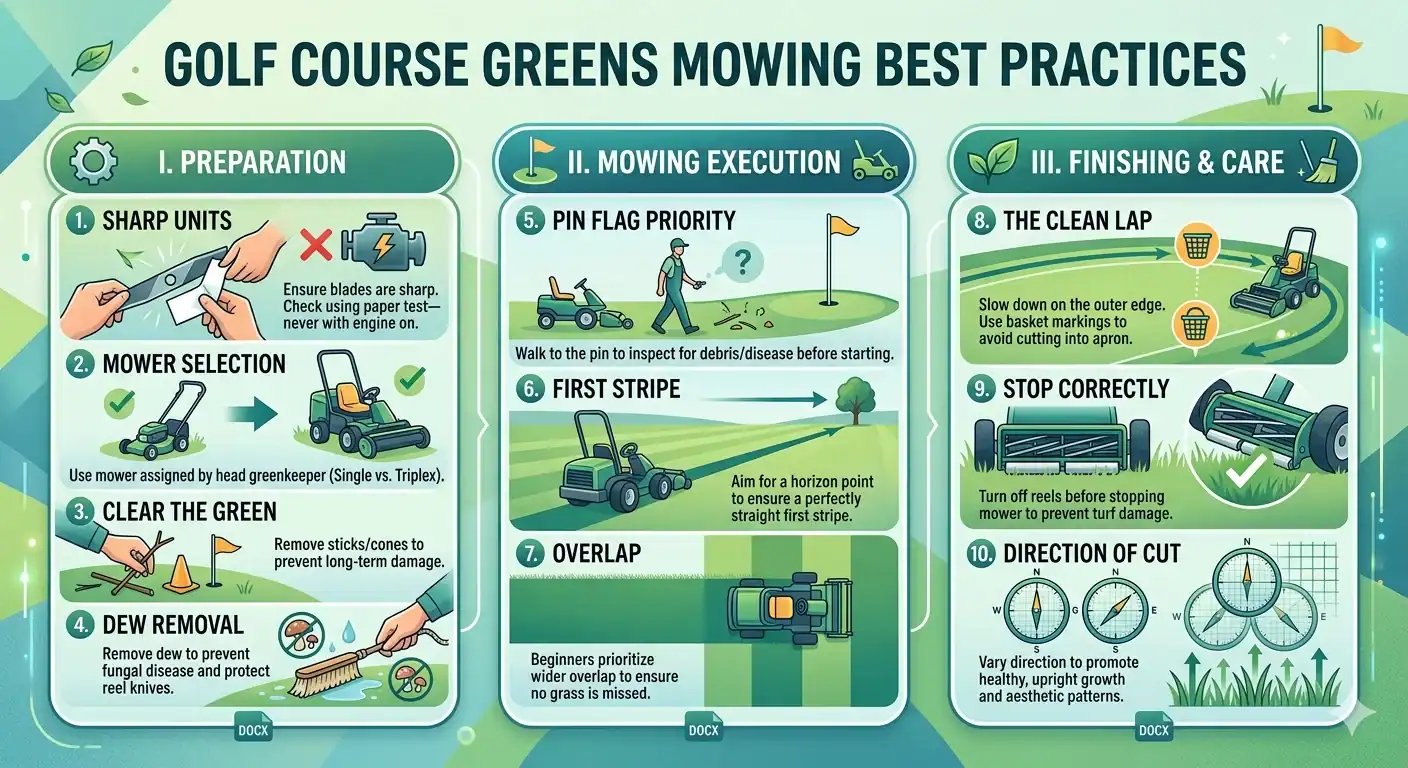
Summary Table: The 10 Steps to Greenkeeping Perfection Mowing Golf Greens
| Mowing Step | Core Focus & Action | Key Turf & Maintenance Benefit |
|---|---|---|
| 1. Sharp Mower Units | Perform a daily paper test between the reel and bedknife. Clean units thoroughly after every use. | Prevents bruised grass leaf tips, reduces disease stress, and ensures a clean cut. |
| 2. Mower Type Choice | Select walk-behind single mowers for top precision, or triplex riding mowers for speed. | Matches course aesthetic requirements with labor availability and efficiency. |
| 3. Surface Debris Sweep | Scan the green surface and manually remove any small sticks, stones, or pine cones. | Prevents costly damage to the bedknife and avoids leaving ugly scars across the putting surface. |
| 4. Dew Management | Remove heavy morning moisture using a hose, rope, or dew brush before cutting. | Minimizes fungal disease pressures and stops wet grass clump buildup on mower blades. |
| 5. Pin Flag Removal | Walk onto the green to remove the flag completely before starting your pass. | Guarantees straight mowing lines and allows a thorough visual check for pitch marks. |
| 6. First Stripe Alignment | Lock your vision onto a distant, fixed horizon marker to guide the very first pass. | Establishes a perfectly straight baseline for all subsequent passes to follow. |
| 7. Precise Line Overlap | Use the visual edges of the grass catcher basket to maintain a slight, consistent overlap. | Eliminates missed, uncut strips of grass that instantly ruin a golfer’s true ball roll. |
| 8. Clean Lap Control | Slow down the machine speed dramatically when executing the final perimeter boundary pass. | Prevents accidental scalping or gouging of the taller collar and apron turf grass. |
| 9. Keep Reels Moving | Always shut off or disengage the cutting reels completely before bringing the mower to a stop. | Eliminates devastating grass friction burns that leave yellow, dead spots on the green. |
| 10. Alternating Cut Patterns | Vary the mowing direction daily (e.g., alternating clock faces or diagonal patterns). | Eliminates grass grain direction buildup, producing a faster, more uniform putting surface. |
FAQ About Mowing Golf Greens
How often should golf course golf greens be mowed?
During the active growing season, golf course putting greens should ideally be mowed every single day. Daily mowing maintains a highly consistent turf density and ensures the ultra-smooth, fast ball roll that golfers expect. During periods of extreme heat stress or slow winter growth, superintendents may alternate daily mowing with rolling to give the turfgrass a rest while preserving green speed.

What is the best height of cut (HOC) for mowing golf greens?
The standard height of cut for modern championship golf greens typically ranges between 0.100 inches and 0.125 inches (2.5mm to 3.2mm). The exact height depends entirely on the turfgrass variety (such as Creeping Bentgrass or Ultradwarf Bermudagrass), seasonal weather conditions, and tournament schedules. Cutting lower than 0.100 inches requires advanced turf management practices to prevent root failure and disease.
Should you ever cut or mowing golf greens in the rain?
Mowing golf greens in heavy rain should be avoided whenever possible. Wet turfgrass is highly susceptible to mechanical tearing rather than clean slicing, which bruises the plant tips and invites fungal diseases. Furthermore, heavy mowing equipment operating on waterlogged putting surfaces can cause soil compaction, tracking, and severe mud clumping in the mower baskets.
What is the difference between a triplex mower and a walk-behind green mower?
A walk-behind single flex mower requires the operator to walk behind the unit, offering maximum precision, zero hydraulic leak risks, and significantly less mechanical weight compaction on the perimeter. A triplex mower is a larger, ride-on machine equipped with three cutting units. Triplex mowers are far faster and highly labor-efficient, making them ideal for standard daily maintenance across courses with large acreages.
How to Mow a Perfectly Straight First Stripe on a Golf Green
Achieving a laser-straight first pass is the secret to a beautifully striped putting surface. Because every subsequent pass aligns with the edge of the previous one, any wobble in your initial line will ruin the visual geometry of the entire green. Follow this proven step-by-step technique to lock in a flawless baseline every time.
Duration Time 2 minutes
Step 1: Position the Mower at the True Center Entry Point
Bring your mower to the edge of the green at the widest, central entry point. Align the machine so it is pointing directly across the longest axis of the green. Do not drop the cutting reels yet; ensure the machine is completely straight and stabilized before making any forward movement.
Step 2: Lock Your Eyes on a Distant Horizon Marker
Instead of looking down at the grass or the front rollers of your mower, lift your chin and look completely across the green. Pick a single, distinct, fixed object on the distant horizon—such as a specific tree trunk, a hazard marker, a yardage post, or a bunker edge. This object will serve as your navigational tracking point.
Step 3: Engage the Reels and Commit to the Target
Drop your cutting reels and begin moving forward at a smooth, steady pace. Keep your gaze locked firmly on your distant horizon marker. Treat the mower like a vehicle; if you look directly down at your wheels, you will over-correct every minor bump and create a wavy path. Looking far ahead naturally keeps your path straight.
Step 4: Rely on Peripheral Vision for Edge Micro-Adjustments
As you travel across the green, use only your peripheral vision to monitor the machine’s immediate path. Keep your primary focus anchored to that distant target point. Maintain uniform, steady pressure on the handle bars if walking, or a relaxed, firm grip on the steering wheel if riding, allowing the machine to track smoothly over the contours.

Step 5: Drive Completely Off the Green Before Turning
Maintain your straight line until the mower has fully exited the putting surface and crossed onto the collar turf. Do not begin steering into your turnaround loop while the rear rollers are still on the green, as this will distort the end of your stripe and scalp the perimeter. Once completely clear, turn off the reels and prepare for your return pass.
Mowing Golf Greens Conclusion: Elevating Your Greenkeeping Artistry
Mastering the art of mowing golf greens is a definitive milestone for any professional greenkeeper. It is a daily task that demands an identical blend of mechanical precision, agronomic awareness, and technical skill. By implementing these ten professional steps—from maintaining razor-sharp reel units to varying your daily cut directions—you protect the long-term health of your turfgrass while delivering the elite, true-rolling putting surfaces that players love.
Pristhine greens do not happen by accident; they are the direct result of consistent, disciplined habits executed every single morning. Take these steps out onto the course, commit to the details, and watch your putting surfaces transform into the crown jewels of your facility. Mowing golf greens to perfection needs practice!

Head greenkeeper in Gothenburg, Sweden, working in the turf industry since 2018. Passionate about sustainable maintenance and new technologies, he focuses on innovative ways to improve turf quality while reducing environmental impact.
The founder of this independent platform, created to connect turf professionals and enthusiasts, share knowledge, and highlight the evolving role of greenkeepers worldwide.
When not on the course, he enjoys exploring golf destinations, writing about turf management, and engaging with the international greenkeeping community. A big fan of Swedish football — especially the Allsvenskan — and an enthusiastic Football Manager player. Beyond turf and football, a happy father and husband.