

Water availability is becoming one of the most critical challenges facing golf course management worldwide. Increasing environmental regulations, prolonged drought periods and competition for potable water resources are forcing golf facilities to explore alternative irrigation sources.
One of the fastest-growing solutions is the use of reclaimed water, also known as recycled wastewater or grey water. While this resource offers significant environmental and economic advantages, it also introduces a unique set of agronomic challenges that require a fundamentally different management approach.

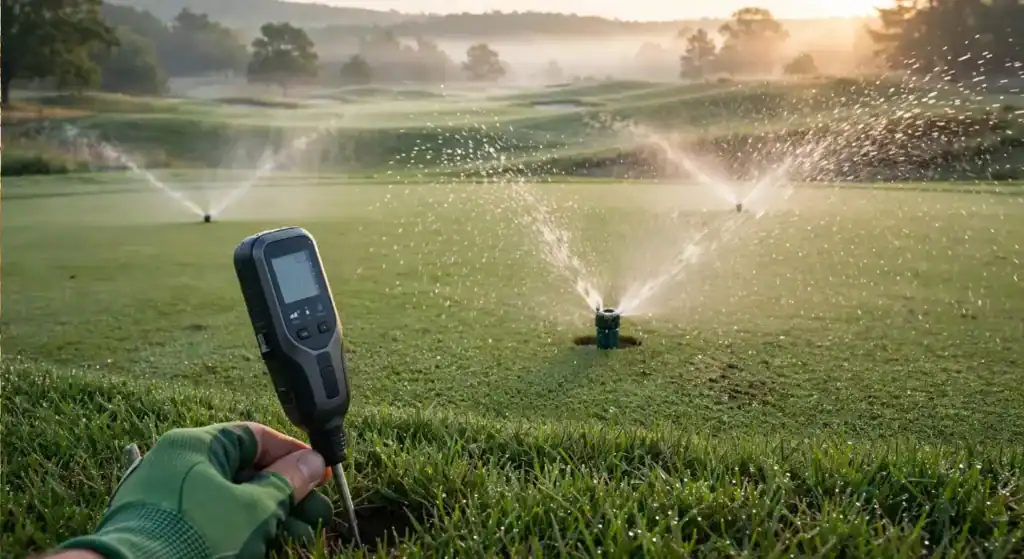
At Black Water Links Golf Club in Poland, reclaimed municipal wastewater forms the backbone of the irrigation strategy. This experience provides valuable insights into both the opportunities and limitations of this increasingly important water source.
The Benefits of Reclaimed Water
Water Security
The most obvious advantage is reliable water availability. Courses relying on potable water or natural surface reservoirs are increasingly vulnerable to drought restrictions and regulatory limitations.
Reclaimed water offers a predictable and sustainable supply, allowing facilities to maintain playing quality even during prolonged dry periods.
Environmental Sustainability
Using recycled wastewater reduces pressure on freshwater resources and supports responsible water stewardship. In many regions, it may become the only socially acceptable irrigation source for golf courses in the future.
Nutrient Contribution
Reclaimed water often contains measurable amounts of nitrogen, phosphorus, potassium and micronutrients. While this can reduce fertilizer requirements, it also creates new management considerations.
The Hidden Challenges
Despite its advantages, reclaimed water is not simply “free irrigation water.” Its chemical composition can significantly influence soil performance, turf health and long-term sustainability.
Elevated pH and Bicarbonates
One of the most common issues is high pH and elevated bicarbonate concentrations.
At Black Water Links, soil pH values frequently range between 7.7 and 8.2. Such alkaline conditions can reduce nutrient availability, particularly phosphorus, iron, manganese and zinc.
In many cases, nutrient deficiencies observed in turf are not caused by a lack of nutrients in the soil, but by chemical lock-up resulting from excessive alkalinity.
Sodium Accumulation
Many reclaimed water sources contain elevated sodium concentrations.
Over time, sodium can:
- Reduce infiltration rates
- Disrupt soil structure
- Increase surface sealing
- Restrict root development
- Decrease oxygen availability
Monitoring SAR (Sodium Adsorption Ratio) becomes essential when evaluating reclaimed water suitability.
Salinity Management
Electrical conductivity (EC) levels are often higher than in freshwater sources.
Without adequate leaching and drainage, salt accumulation can negatively impact turf performance and species composition.
This is one reason why salt-tolerant turfgrass species become increasingly important on reclaimed-water golf courses.
Monitoring Is Everything
Successful reclaimed water management requires more than standard irrigation scheduling.
A modern monitoring programme should include:
- Water pH
- Bicarbonates (HCO₃⁻)
- Electrical Conductivity (EC)
- Sodium (Na)
- Calcium (Ca)
- Magnesium (Mg)
- Chloride (Cl)
- SAR
- Soil pH
- Organic matter levels
- Infiltration rates
Without regular testing, managers are effectively operating blind.
Practical Management Strategies
Acidification
Where bicarbonates are high, acid injection systems can significantly improve water quality before irrigation.
Calcium-Based Programmes
Gypsum applications can help displace sodium from the soil exchange complex and improve soil structure.
Acidifying Fertility
Nitrogen sources such as ammonium sulphate can gradually lower rhizosphere pH and improve nutrient availability.
You may also like

Species Selection
Future golf courses irrigated with reclaimed water will increasingly rely on turf species capable of tolerating salinity and alkalinity.
Species selection should become part of the water management strategy.
Maximising Soil Oxygen
Maintaining infiltration, drainage and oxygen exchange becomes even more important when reclaimed water is used.
Aeration, topdressing and organic matter management remain critical cultural practices.
The Future of Golf Irrigation
The conversation around reclaimed water should not focus solely on the problems it creates.
The reality is that recycled water may become the primary irrigation source for many golf courses within the next decade.
The challenge for turf managers is not whether reclaimed water should be used, but how to adapt management systems to its unique characteristics.
Golf courses that embrace data-driven decision-making, monitor water chemistry and adjust agronomic programmes accordingly will be best positioned to thrive in an increasingly water-constrained world.
At Black Water Links, reclaimed water is not viewed as a limitation. It is simply another agronomic variable that must be understood, measured and managed.