

Dollar spot (Clarireedia spp.) has evolved from an occasional summer nuisance into one of the most persistent and costly threats facing golf course managers across Europe and Northern Europe. With changing climatic conditions, longer periods of warm humidity, and evolving fungicide regulations, reliance on purely reactive spraying is no longer viable.
Implementing a modern Dollar Spot turf management program requires a proactive, Integrated Pest Management (IPM) approach combining environmental monitoring, targeted cultural practices, and precision chemistry.
This comprehensive guide breaks down the science behind the disease, how to utilize predictive disease forecasting like the Smith-Kerns model, and the essential steps required for successful Dollar Spot turf management on fine turf surfaces year-round.
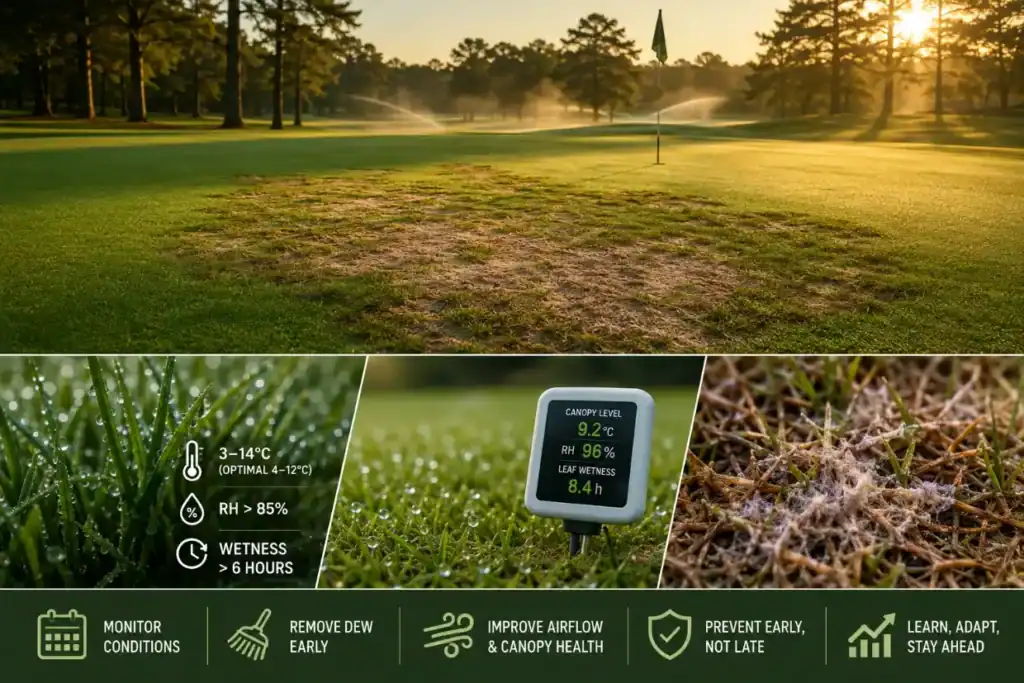
Historically viewed as a mid-summer challenge, survey data from industry research (including Syngenta’s Dollar Spot State of the Nation study) reveals that disease activity now spans a much longer period than ever before. While outbreaks peak between July and September, initial disease activity is routinely detected as early as March and April, stretching well into November.
Several factors complicate effective Dollar Spot turf management:
- Extended Warmth and Humidity: Milder springs and prolonged autumn weather keep soil temperatures in the active range for Clarireedia species longer.
- Complex Species Dynamics: Researchers have identified at least six distinct species of Dollar spot pathogens, each displaying subtle differences in temperature tolerance and turf host interactions.
- Lowered Nitrogen Inputs: Environmental regulations and management trends toward leaner nutrition regimes have left turfgrass more vulnerable to infection.
Key Takeaway: A plant under nutrient or moisture stress combined with extended leaf wetness creates the ideal window for Dollar spot colonization.
Symptom Identification and High-Risk Areas
Dollar spot manifests as small, silver-dollar-sized sunken spots (2–5 cm in diameter) on closely mown turf, which can coalesce into large, irregular dead patches if left unmanaged. On leaves, distinct hourglass-shaped lesions with reddish-brown margins are characteristic.
Occurrence across Golf Course Zones
Data from field surveys indicates that Dollar spot is not restricted to putting surfaces:
| Zone | Outbreak Occurrence (% of Reported Cases) | Key Risk Drivers |
|---|---|---|
| Greens | 64% | High stress from ultra-low cutting heights, foot traffic |
| Tees | 50% | Leaner fertility programs, heavy divot scarring |
| Surrounds / Approaches | 36% | Infrequent dew removal, variable moisture control |
| Fairways | 26% | High acreage, limited chemical intervention budget |
While putting greens represent the highest reported location due to strict aesthetic and playability standards, less intensely managed areas like tees and surrounds frequently harbor active inoculum that spreads across the course.
Predictive Modeling: Utilizing the Smith-Kerns Model
Proactive Dollar Spot turf management relies heavily on environmental forecasting. The Smith-Kerns (SK) Model calculates a daily 5-day rolling probability of Dollar spot infection based on relative humidity and mean daily temperature.

SK Infection Risk Thresholds:
├── < 15% Risk   : Low risk – Focus on routine cultural practices
├── 15% - 20%    : Moderate risk – Heightened visual monitoring on indicator greens
└── > 20% Risk   : Danger Zone – Pathogen active; condition ripe for scarring
Establishing Local “Trigger Values”
The standard 20% Smith-Kerns risk threshold was originally calibrated on older cultivars of creeping bentgrass (Agrostis stolonifera). Modern Dollar Spot turf management in Nordic and European climates shows that local factors alter when symptoms appear:
You may also like

- Identify Indicator Greens: Designate 1–2 greens on your course that historically show the earliest disease symptoms under stress.
- Track Microclimates: Enclosed greens surrounded by trees or lacking air movement will trigger outbreaks at lower SK threshold scores than open, breezy greens.
- Use Untreated Check Strips: Where feasible, maintain a small, untreated monitoring area to calibrate your facility’s specific trigger value against live digital model readouts (such as the Syngenta Turf Advisor app).
5 Core Cultural Practices for Dollar Spot Turf Management
Cultural practices form the backbone of any sustainable IPM program. Implementing robust mechanical and agronomic routines reduces pathogen inoculum and extends the window before chemical intervention becomes necessary.
1. Daily Rolling (Turf Lightweight Rolling)
Frequent rolling is the single most effective mechanical practice for suppressing Dollar spot. Rolling removes leaf dew, closes micro-fissures in the canopy, and alters surface moisture dynamics without increasing soil compaction.
- Optimal Frequency: 5 to 7 days per week during high-risk windows.
- Impact: Studies show courses rolling 6–7 times weekly experience up to 70% fewer Dollar spot outbreaks compared to unrolled surfaces.
2. Strategic Nitrogen Nutrition
Dollar spot is fundamentally a disease of nitrogen-starved turf. Low nitrogen slows leaf growth, reducing the plant’s ability to outgrow fungal infection.
- Application Strategy: Implement regular, low-dose “spoon-feeding” applications of soluble nitrogen (1.5 to 4 kg N/ha per week depending on species and local soil tests).
- Threshold Data: Survey data reveals that greens receiving less than 90 kg total N/ha/year reported significantly higher Dollar spot incidence (>50% occurrence) than adequately fertilized surfaces.
3. Leaf Dew Removal
Leaf wetness duration is a primary catalyst for fungal spore germination. Allowing morning dew to sit on the turf canopy until midday dramatically accelerates infection.
- Action: Prioritize morning dew clearing (via switching, brushing, or mowing) across all high-value surfaces. Vary morning work schedules so the same greens are not consistently left wet until last.
4. Precision Moisture Management
Drought-stressed turf grass is far more susceptible to infection. Maintaining a uniform, adequate Volumetric Water Content (VWC) protects canopy health.
- Target Moisture: Maintain soil moisture levels around 21%–25% VWC.
- Risk Zone: When moisture drops below 20% VWC, reported Dollar spot outbreaks rise above 60% due to localized plant stress.
- Tools: Incorporate a comprehensive wetting agent program to eliminate hydrophobic dry spots and maintain uniform soil moisture profiles.
5. Biostimulants & Plant Health Boosters
While biostimulants do not directly control fungal pathogens, applying amino acids, seaweed extracts, and humic substances during stress periods helps maintain root mass and cellular turgor. Healthy plants recover faster from minor leaf lesions before permanent scarring occurs.
Precision Fungicide Strategies and IPM Integration
When environmental conditions sustain high disease pressure (Smith-Kerns model maintaining >20% for consecutive days), chemical intervention becomes a necessary layer in Dollar Spot turf management to prevent catastrophic turf loss and surface scarring.
Timing for Maximum Efficacy
- Early-Season Protection: Applying protective fungicide treatments when the pathogen first becomes active in late spring significantly suppresses total seasonal inoculum.
- Avoid Premature Applications: Treating before soil temperatures initiate fungal activity wastes active ingredients without delivering seasonal disease reduction.
- Curative vs. Preventive: Preventive applications made during rising SK risk periods achieve up to 70% greater control than curative sprays applied after visible lesions and scars have appeared.
Fungicide Selection & Rotation
Rotating active ingredients with different Modes of Action (FRAC codes) is mandatory to prevent fungicide resistance—a documented challenge with Clarireedia pathogens.
You may also like
Targeted Fungicide Rotation Strategy:
├── High-Pressure Window : Ascernity® (SDHI + DMI combination)
├── Transition Protection: Instrata® Elite (Fludioxonil + Difenoconazole)
└── Alternate Disease Target: Reserve contact options (e.g., Medallion®) for Microdochium / Anthracnose
Note: Always verify local product registrations and chemical regulations in your specific country before application.
Managing Multi-Disease Pressure & Winter Transitions
Effective Dollar Spot turf management cannot exist in isolation. As summer shifts into autumn, greenkeepers in cool climates face compound disease challenges, including Microdochium patch (Microdochium nivale) and Anthracnose (Colletotrichum cereale).
Transition Checklist for Autumn & Winter Readiness:
- Shift Focus on Nutrition: Gradually phase out high-growth nitrogen applications by late autumn while maintaining adequate potassium and iron levels to toughen cell walls.
- Raise Height of Cut (HOC): Raising HOC slightly going into late autumn increases photosynthetic capacity and stress resistance against winter pathogens.
- Control Organic Matter: Excess thatch holds moisture near the crown, favoring winter mold development and providing over-wintering structures for fungal mycelium.
- Air Circulation & Light: Prune surrounding trees to increase sunlight penetration and air movement across vulnerable greens during short winter days.
Frequently Asked Questions (FAQ)
What is the most effective Dollar Spot turf management strategy?
The most effective Dollar Spot turf management strategy combines regular lightweight rolling (5–7 days per week), maintaining adequate soil nitrogen levels (avoiding lean nitrogen stress), precise leaf dew removal, and monitoring humidity and temperature triggers using the Smith-Kerns disease forecasting model.
What temperature and moisture conditions trigger Dollar spot?
Dollar spot (Clarireedia spp.) thrives when warm day temperatures (20°C to 30°C / 68°F to 85°F) combine with cool nights, high atmospheric humidity (>85%), and prolonged periods of leaf wetness or dew retention on the turf canopy.
Why is nitrogen nutrition critical in Dollar Spot turf management?
Dollar spot is fundamentally a disease of nitrogen-starved turfgrass. Adequate nitrogen promotes steady leaf growth, allowing the grass plant to continuously outgrow fungal infection and recover rapidly from surface lesions before visible scarring occurs.
How does the Smith-Kerns model aid in Dollar Spot turf management?
The Smith-Kerns (SK) Model calculates a 5-day rolling probability of Dollar spot infection based on daily humidity and mean temperatures. In modern Dollar Spot turf management, greenkeepers use the model to apply preventive treatments right when disease pressure enters high-risk thresholds (typically above 15%–20% risk), preventing visible turf damage.
Does lightweight rolling really help control Dollar spot?
Yes. Field research shows that daily lightweight turf rolling (6 to 7 times per week) can reduce Dollar spot incidence by up to 70%. Rolling mechanically disperses leaf dew, alters canopy surface moisture, and closes micro-fissures where fungal spores establish.

By pairing real-time disease forecasting with disciplined cultural maintenance and rotational chemistry, golf course managers can master Dollar Spot turf management while maintaining premier playing conditions. For more expert guides on turfgrass agronomy and course management, visit Greenkeeping Insight.

Head greenkeeper in Gothenburg, Sweden, working in the turf industry since 2018. Passionate about sustainable maintenance and new technologies, he focuses on innovative ways to improve turf quality while reducing environmental impact.
The founder of this independent platform, created to connect turf professionals and enthusiasts, share knowledge, and highlight the evolving role of greenkeepers worldwide.
You may also like

When not on the course, he enjoys exploring golf destinations, writing about turf management, and engaging with the international greenkeeping community. A big fan of Swedish football — especially the Allsvenskan — and an enthusiastic Football Manager player. Beyond turf and football, a happy father and husband.