
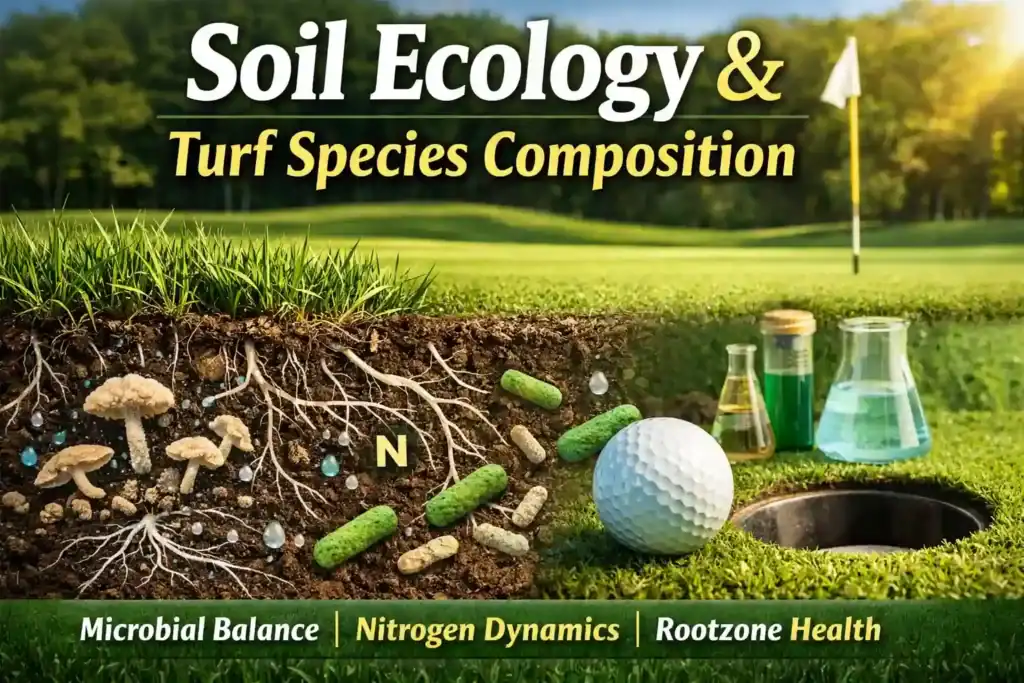
The composition of turfgrass species on golf putting greens is traditionally considered to be primarily influenced by seed selection, fertilization programs, and irrigation management. However, increasing evidence from soil ecology and turfgrass science suggests that the underlying soil ecosystem plays a decisive role in determining long-term turf species dominance.
Interactions between soil microorganisms, nutrient cycling dynamics, oxygen availability in the rootzone, and management practices collectively shape the ecological conditions that favor either perennial turf species such as Agrostis spp. and Festuca spp., or opportunistic species such as Poa annua.
This article examines the role of soil microbial balance, nitrogen management, and rootzone conditions in shaping turfgrass composition on golf greens and discusses practical management strategies that can promote stable perennial turf systems.
The Role of Microbial Balance, Nitrogen Dynamics, and Rootzone Environment
Golf course turf management has historically focused on agronomic practices including fertilization, irrigation, mowing regimes, and mechanical maintenance. While these practices remain fundamental to maintaining high-quality playing surfaces, recent developments in soil ecology highlight the importance of biological processes occurring within the rootzone.
The soil environment beneath a golf green represents a complex ecosystem consisting of plant roots, microorganisms, organic matter, water, air, and mineral particles. Within this system, microbial communities regulate nutrient cycling, influence soil structure, and affect plant health and competitiveness.
Consequently, turf species composition on putting greens may be less a function of seed selection alone and more a product of the ecological conditions created through management practices.
Understanding these interactions is becoming increasingly relevant as golf courses seek to develop more sustainable and resilient turf systems.
Ecological Strategies of Turfgrass Species
Turfgrass species differ significantly in their ecological strategies.
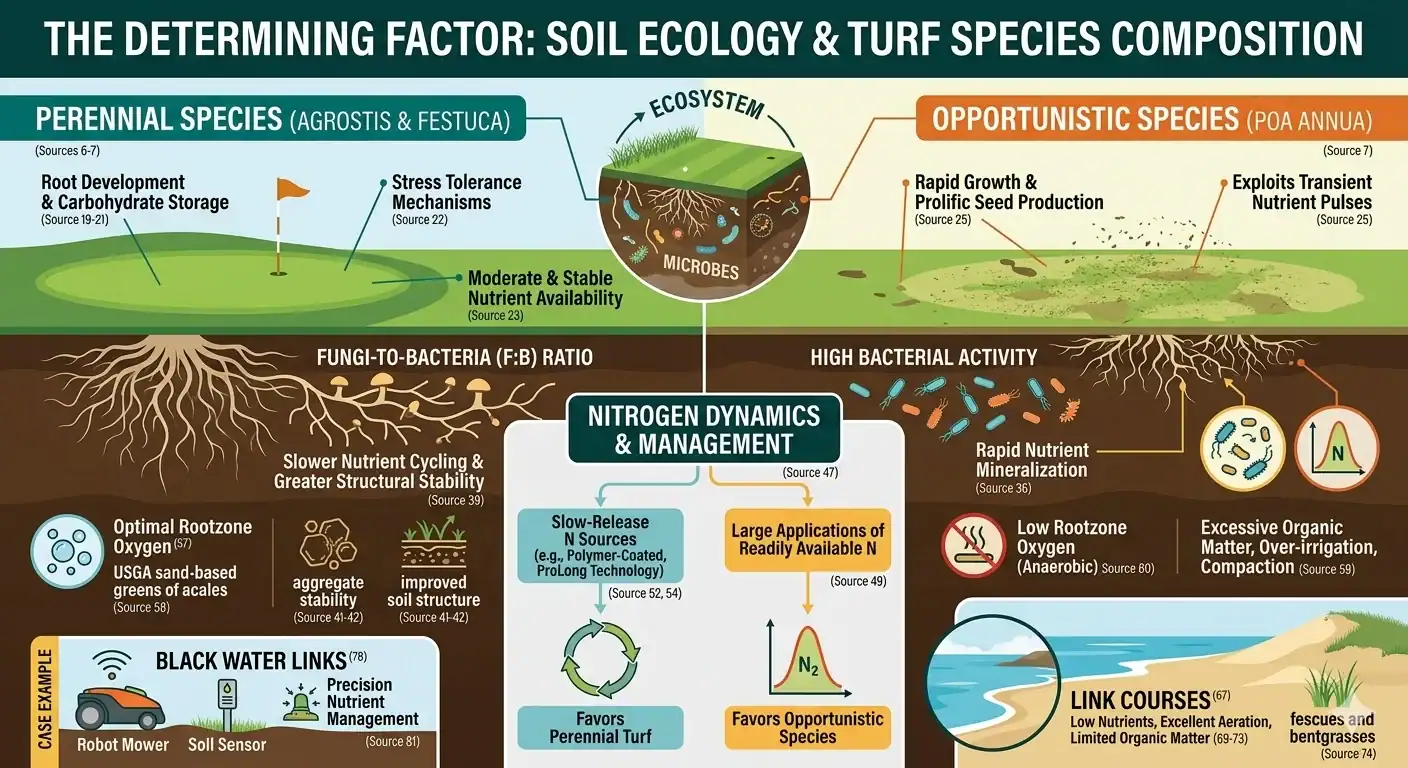
Perennial species commonly used on golf greens, particularly creeping bentgrass (Agrostis stolonifera) and fescues (Festuca rubra complex), are characterized by strategies associated with long-term environmental stability.
These species allocate significant physiological resources to:
- root development
- carbohydrate storage
- stress tolerance mechanisms
Such adaptations allow perennial grasses to persist in environments where nutrient availability is moderate and relatively stable.
In contrast, annual bluegrass (Poa annua) represents a classic opportunistic species within disturbed ecosystems. Its life strategy prioritizes rapid growth, prolific seed production, and the ability to exploit transient nutrient availability.
Poa annua thrives in environments characterized by:
- high nitrogen availability
- fluctuating soil moisture
- reduced oxygen availability in the rootzone
- frequent surface disturbance
These conditions are frequently encountered in intensively managed turf systems.
Thus, in many cases, the dominance of Poa annua reflects ecological conditions rather than inherent competitive superiority.
Soil Microbiology and the Fungi-to-Bacteria Ratio
One of the most informative indicators of soil ecological dynamics is the fungi-to-bacteria ratio (F:B).
This ratio describes the relative abundance of fungal biomass compared to bacterial biomass in soil microbial communities.
Soils dominated by bacterial activity typically exhibit rapid nutrient mineralization and accelerated decomposition of organic matter. Nitrogen becomes available quickly in mineral form, often resulting in rapid shoot growth responses in plants.
Such environments frequently favor opportunistic plant species that are capable of exploiting short-term nutrient pulses.
You may also like

In contrast, fungal-dominated or fungal-balanced soils are associated with slower nutrient cycling and greater structural stability.
Fungal hyphae form extensive networks within soil that contribute to:
- aggregate stability
- improved soil structure
- gradual nutrient release
- enhanced root–soil interactions
These conditions tend to favor perennial plant species adapted to stable environments.
Studies in turfgrass systems suggest that increasing fungal activity within the rootzone may contribute to improved root development and greater turf stability over time.
Nitrogen Dynamics and Turf Ecosystem Stability
Nitrogen management plays a critical role in shaping the soil microbial environment.
Large applications of readily available nitrogen fertilizers can stimulate rapid bacterial activity in the soil. This leads to accelerated mineralization processes and short-term increases in nitrogen availability.
While this may produce rapid turf growth, it also creates ecological conditions favorable to opportunistic species such as Poa annua.
In contrast, slow-release nitrogen sources promote more gradual nutrient availability. This moderates microbial activity and contributes to a more stable nutrient cycle within the soil ecosystem.
Technologies designed to regulate nitrogen release, including polymer-coated fertilizers and advanced nutrient delivery systems such as ProLong technology, aim to provide a more consistent nutrient supply to turfgrass plants.
By reducing nitrogen spikes and stabilizing nutrient availability, these approaches may help create environmental conditions more favorable for perennial turf species.
Rootzone Oxygen and Soil Physical Conditions
Another critical factor influencing turf species composition is oxygen availability within the rootzone.
Sand-based greens constructed according to USGA recommendations are designed to promote rapid drainage and maintain adequate aeration. However, excessive organic matter accumulation, over-irrigation, or compaction can reduce oxygen availability.
Low oxygen environments favor microbial processes dominated by anaerobic bacteria and can inhibit deep root development.
Opportunistic species such as Poa annua often tolerate these conditions more effectively than perennial turf species.
Maintaining adequate aeration through:
- mechanical aeration
- topdressing programs
- controlled irrigation
is therefore essential in sustaining favorable conditions for perennial grasses.
Lessons from Traditional Links Courses
Traditional links courses offer valuable insight into ecological turf management.
These environments are typically characterized by:
- sandy soil profiles
- low nutrient availability
- excellent natural aeration
- limited organic matter accumulation
Such conditions naturally support slow nutrient cycling and stable soil structure, often resulting in ecosystems dominated by fescues and bentgrasses.
Although modern golf course maintenance often differs significantly from traditional links management, the ecological principles underlying these systems remain relevant.
Case Example: Ecosystem-Based Management Approaches
Some modern golf courses are increasingly adopting management strategies that emphasize ecosystem stability rather than intensive inputs.
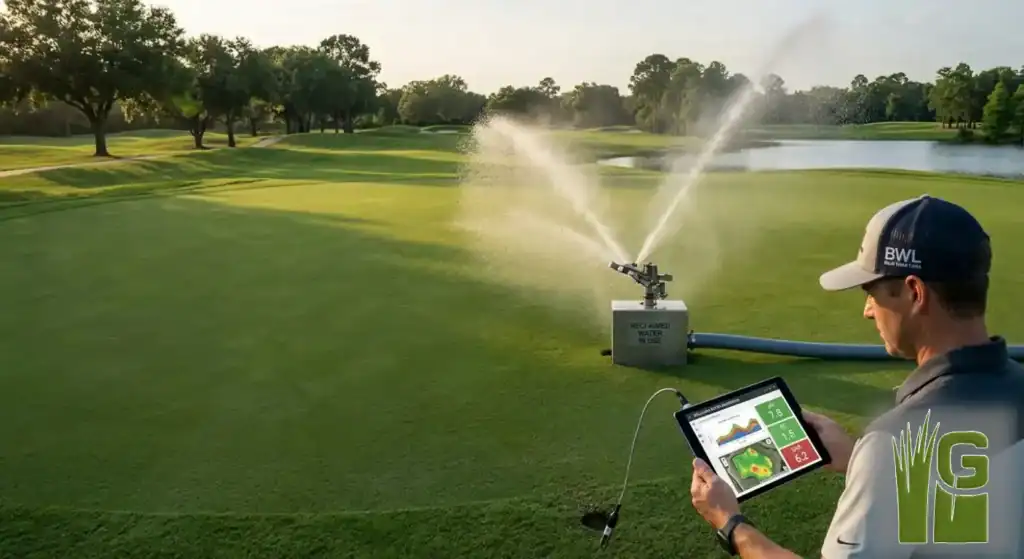
At facilities such as Black Water Links, management approaches integrate technological tools including:
- soil moisture sensors
- robotic maintenance systems
- precision nutrient management
These technologies allow turf managers to maintain high playing quality while minimizing unnecessary environmental disturbance.
By focusing on stable soil conditions, balanced nutrient inputs, and improved rootzone oxygen availability, such approaches aim to promote long-term dominance of perennial turf species.
Conclusion
The species composition of turfgrass on golf greens cannot be explained solely by seed selection or surface management practices.
Instead, it reflects the ecological dynamics of the soil environment, including microbial communities, nutrient cycling, and physical rootzone conditions.
You may also like

Management practices that promote stable nutrient availability, adequate aeration, and balanced microbial ecosystems are more likely to support perennial turf species such as bentgrass and fescue.
Conversely, environments characterized by nutrient pulses, excessive moisture, and frequent disturbance often favor opportunistic species such as Poa annua.
As golf course management continues to evolve toward greater sustainability and ecological awareness, soil ecology will likely play an increasingly important role in determining the future composition of putting greens.
Ultimately, the dominant grass species on a green are not simply planted.
They are selected by the ecosystem beneath the surface.
FAQ – Soil Ecology
What is soil ecology and why is it important for golf greens?
Soil ecology refers to the interactions between microorganisms, organic matter, and environmental conditions within the soil. In golf greens, soil ecology is essential because it influences nutrient cycling, root development, and ultimately turf species composition.
How does soil ecology affect turf species composition?
Soil ecology determines how nutrients are released and how microbial communities function in the rootzone. A balanced soil ecology promotes stable growing conditions that favor perennial turf species, while poor soil ecology can encourage opportunistic species like Poa annua.
Can improving soil ecology reduce the presence of Poa annua?
Yes, improving soil ecology can help reduce Poa annua dominance. By creating a more stable soil ecology with consistent nutrient availability and better aeration, soil ecology becomes less favorable for opportunistic species.
What management practices support healthy soil ecology?
Practices such as controlled nitrogen application, proper aeration, and organic matter management all contribute to a healthier soil ecology. These approaches strengthen soil ecology by maintaining microbial balance and improving long-term turf stability.
Is soil ecology more important than fertilization and irrigation?
Soil ecology works together with fertilization and irrigation rather than replacing them. However, without proper soil ecology, these practices may lead to unstable conditions that negatively impact turf performance.



Pingback: Modern Greenkeeping Innovation: The Future of Turf in 2026
Absolutely — and this is exactly where many still fall behind. Texture and drainage are just the starting point. The real performance driver today is biology: microbial balance, fungal dominance, and how we manage that system to support plant health naturally.
Pingback: Soil Biology - Focused Turf Management. Healthy Turf