
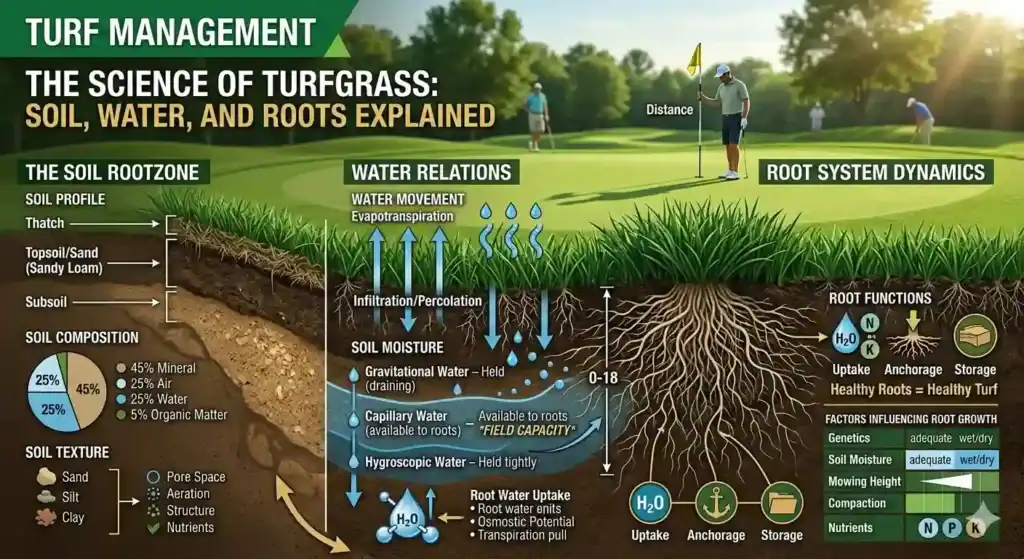
When golfers talk about a “perfect green,” they usually think about speed, smoothness, and colour. But what makes turfgrass healthy has much less to do with what we see on the surface and much more to do with what happens underneath our feet. Soil, water, and roots form a quiet system that decides whether a golf course thrives or struggles.Read about the science of Turfgrass
Turfgrass is a living plant. Like all plants, it needs air, water, nutrients, and space to grow. Unlike many garden plants, turf is cut very short, walked on every day, and expected to recover quickly. This makes turfgrass science both fascinating and demanding.
The Foundation: Why Soil Composition Matters
Everything starts with the soil. Soil is not just “dirt.” It is a complex mix of mineral particles, organic matter, water, and air. On golf courses across Europe, soils can vary a lot—sandy coastal soils, heavy clay inland, or carefully constructed rootzones on modern greens. Each type behaves differently, especially when it comes to water movement and oxygen.
Good turf soil must drain well but still hold enough moisture. If water sits in the soil for too long, roots suffer because they cannot breathe. Roots need oxygen just as much as they need water. This is why sand-based rootzones are common on greens: sand creates air spaces that allow oxygen to reach the roots and excess water to drain away.
Nutrition and The Delicate Balance
But sand alone is not enough. Turf also needs nutrients, which come from organic matter and fertilisers. Too little nutrition leads to weak growth; too much leads to soft turf and disease problems. The balance is delicate, and this is where greenkeepers use soil testing, experience, and careful planning.
Smart Irrigation: More Isn’t Always Better
Water is the next key part of the system. Grass needs water to survive, but more water does not always mean better turf. In fact, overwatering is one of the most common mistakes in turf management. When soil stays constantly wet, roots stay shallow. Shallow roots make turf weak, sensitive to stress, and more dependent on irrigation.
Deep, healthy roots develop when turf is watered correctly. This usually means watering less often but more deeply, encouraging roots to grow downwards in search of moisture. On European golf courses, this is especially important during dry summers and water-restricted periods. Efficient irrigation is not only good for turf, but also for sustainability and costs.
[Image comparing shallow roots from overwatering vs deep roots from infrequent watering]
Roots: The Hidden Workforce
Roots are the hidden workforce of turfgrass. They anchor the plant, absorb water and nutrients, and store energy. Healthy roots mean healthy turf above ground. When golfers see turf thinning, yellowing, or failing to recover, the problem is often below the surface.
One interesting fact many golfers don’t know is that turfgrass roots are constantly renewing themselves. Old roots die, new roots grow, and this cycle changes with seasons, temperature, and maintenance practices. Stress, such as heat, drought, compaction, or disease, can interrupt this cycle and weaken the entire plant.
The Enemies of Growth: Compaction and Temperature
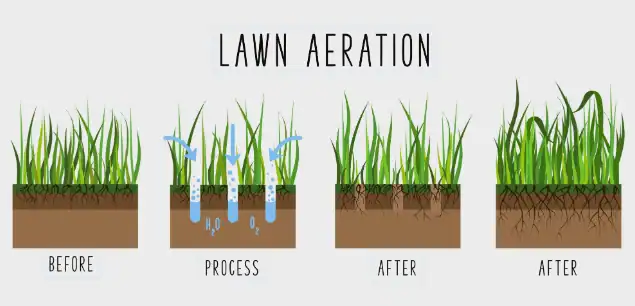
Soil compaction is another major enemy of roots. When foot traffic, machinery, or play press soil particles too close together, air spaces disappear. Water may sit on the surface, roots struggle to grow, and turf becomes thin.
This is why greenkeepers aerate greens and fairways. Aeration creates space for air and water, helping roots recover and grow deeper.
Temperature also plays a role. Cool-season grasses, common across Europe, grow best when soil temperatures are moderate. When soil becomes too cold or too hot, root growth slows down even if the grass looks green on top. This is why turf can sometimes look fine but suddenly decline when conditions change.
Biology Over Chemicals
Disease and pests often attack turf when roots are already under stress. Weak roots mean weak defences. Healthy soil biology—including beneficial microorganisms—helps protect turf naturally. This is one reason modern greenkeeping focuses more on soil health and less on quick chemical solutions.
A New Perspective for the Player
For golfers, understanding this hidden science can change how they see the course. Temporary greens, slower speeds, or aeration holes are not signs of neglect. They are often signs that greenkeepers are protecting the long-term health of the turf. What happens below the surface today decides the quality of play tomorrow.
For turf lovers and future greenkeepers, soil, water, and roots are the foundation of everything. Machines, fertilisers, and technology help, but they cannot replace good fundamentals. Strong roots in healthy soil, supported by smart water use, create resilient turf that can handle play, weather, and time.
Conclusion: The Art of Balance
In the end, turfgrass science is not complicated—it is about balance. Balance between air and water, growth and stress, use and recovery. When this balance is respected, golf courses stay green, playable, and sustainable. And the next time you walk across a green, remember: the real work is happening where you cannot see it.
FAQ: Understanding The Science of Turfgrass
What are the three pillars of the science of turfgrass?
The foundation of healthy turf relies on the relationship between soil, water, and roots. While golfers focus on the surface, the science of turfgrass teaches us that the quality of play is determined by how well these three elements are balanced underground. Soil provides the structure, water provides the life, and roots act as the engine that sustains the plant.
Why is soil composition so important for golf greens?
In the science of turfgrass, soil isn’t just “dirt”—it is a precise mix of minerals, air, and organic matter. Many modern greens use sand-based rootzones because sand creates essential air pockets. These gaps allow oxygen to reach the roots while ensuring excess water drains away, preventing the grass from “suffocating” in waterlogged conditions.
How does watering affect root depth?
The science of turfgrass shows that watering frequency directly impacts root strength. Overwatering leads to “lazy,” shallow roots because the plant doesn’t have to search for moisture. Conversely, watering deeply but less frequently encourages roots to grow further down into the soil, creating a more resilient and drought-resistant plant.
Why do greenkeepers aerate the course?

Aeration is a vital practice in the science of turfgrass used to combat soil compaction. When heavy machinery or foot traffic presses soil particles too tightly together, air and water can no longer reach the roots. By punching holes in the turf, greenkeepers create space for the soil to “breathe,” allowing roots to expand and stay healthy.
Can turfgrass be unhealthy even if it looks green?
Yes. A key principle in the science of turfgrass is that surface appearance can be deceiving. Factors like extreme soil temperatures or nutrient imbalances can stress the root system long before the grass turns brown. Healthy soil biology and a robust root cycle are the true indicators of long-term turf health, rather than just temporary greenness.

I live where turf meets tech, science meets sod, and tradition meets tomorrow.
A curious mind with a passion for the ground beneath the game, this space is dedicated to exploring the innovations, breakthroughs, and sustainable practices that are reshaping golf courses worldwide.
From the latest advancements in grass genetics to the most innovative course management tools, I will highlight the ideas that help the industry grow smarter, play wiser, and think long-term for the planet.
The mission is simple: connect the dots between the lab and the fairway, transforming complex science and cutting-edge tech into clear, compelling stories.
Together, let’s make every course better—one groundbreaking story at a time.