


One of the more responsible tasks awaiting a greenkeeper during their career is the ability to properly set tee markers.
I have the impression that many greenkeepers underestimate this task and therefore do not devote enough attention to it. Poorly positioned tee markers can directly influence a player’s success. Imagine if, during a tournament, a player ruined their round because of incorrectly set tee markers. Do you realize that marker placement can impact player satisfaction, and that in turn affects the success of your golf course?
For less experienced greenkeepers, let’s start with a basic explanation.
What are the Tee and Tee Markers?
Tee
In golf course maintenance terminology, the tee (or teeing ground) is the prepared area from which play is initiated on each hole. It typically features a closely mown turf surface constructed on a level or gently contoured base to ensure consistent stance and ball placement. The turf composition, mowing height, and firmness are managed to provide optimal playing conditions and resistance to wear. Tees may vary in size depending on expected traffic, hole length, and course design strategy.
Tee Markers
Tee markers are fixed or movable objects that define the boundaries of the teeing area for each set of tees on a hole. They indicate the front limits and lateral extent of the playable surface from which a golfer may start play. From a maintenance perspective, tee markers are repositioned regularly to distribute wear evenly across the tee surface and to promote uniform turf recovery. Marker colors or designs distinguish different tee sets, reflecting variations in yardage or level of play (e.g., championship, forward, or junior tees).
Now remember—nothing is more frustrating for a player than arriving at the first hole and immediately encountering difficulties.
That first impression is crucial in shaping the overall perception of the course, and of course, we all want positive feedback.
Rules for Setting Tee Markers
It’s quite straightforward. On PAR 3 holes, markers should always point toward the center of the green—not the pin position, as the pin is not always placed in the center. If you align markers directly to the pin and the hole position changes, your alignment will no longer be correct. Properly aligned markers must always point to the center of the green.
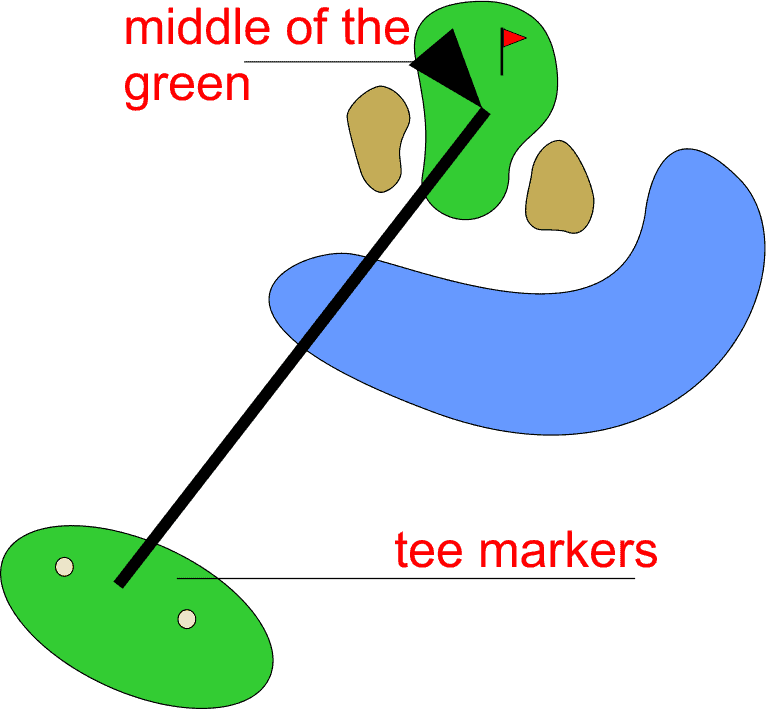
For holes longer than PAR 3, markers should point to the center of the fairway.

Following this rule ensures proper alignment every time.
How to Check Correct Marker Alignment
When standing between the markers—one on your left and one on your right—facing the direction of play, your view should point toward the center of the green (for PAR 3s) or the center of the fairway (for longer holes).
If unsure, stand between the markers, extend your arms so each hand aligns with a marker, then bring them forward to check your direction. If it matches as described, your markers are correctly positioned.
Why Do We Move Tee Markers?
A greenkeeper’s job would be boring if markers never needed moving! From a turf management perspective, markers are moved to allow divot recoveryand give worn areas time to regenerate. From a player’s perspective, marker movement keeps the course interesting—different positions mean different challenges, sometimes easier or harder than the day before.
How to Move Tee Markers
This also follows certain rules—you can’t move markers freely. We distinguish between different tee areas:
| Tee Color | Typical Player Group | Purpose / Notes |
|---|---|---|
| ⚪ White Tees | Professionals and low-handicap men | Longest course setup, used for competitions and elite play |
| 🟨 Yellow Tees | Standard men’s tees | For regular male players and club members |
| 🔴 Red Tees | Women and senior players | Shorter distance to improve playability |
| 🟢 / 🟠 Green or Orange Tees | Juniors, beginners, or fresh players | Significantly shorter layout for learning and enjoyment |
Within each designated tee area (white, yellow, red, etc.), there is usually a flat marker embedded in the ground indicating the midpoint of that teeing ground. To maintain the measured course layout (e.g., PAR 72), markers may be moved up to 10 meters forward or backward from that point. Always ensure at least 1 meter distance from the previous spot to allow recovery.
Additional Guidelines for Moving Markers
The main principle is to maintain the correct distance to the pin. If the pin position is moved to the back of the green,
the tee markers should be moved slightly forward, keeping the total hole distance consistent with signage. Conversely, when the pin moves to the front, markers should shift backward. This requires good communication and planning between greenkeepers to coordinate daily pin and tee positions.
In many courses, pin positions are changed daily, while tee markers are moved around three times a week—daily only on PAR 3 holes, where teeing areas are shorter. The distance between markers should be wide enough for a player to make a full swing comfortably—typically 4 to 5 meters.
When placing markers in extreme front or back positions, maintain at least half a meter distance from the edges of the tee. Likewise, avoid positioning markers too close to the sides; I usually keep a distance of one foot from the edge,
so the markers don’t need to be removed when mowing the tee surrounds
Common practice also allows moving markers within ±10 meters to find the best area, but avoid certain mistakes—for example, don’t place yellow markers all the way forward while red markers are all the way back, as that disrupts fairness between tee sets.
A practical system I’ve developed is to start the season with all markers in the forward-most positions and then gradually move them backward by about one meter each time, until reaching the rear limit. By the time we’re at the back, the front should be fully recovered for reuse. Before we look at common mistakes, remember: during any tournament—whether it’s a club event, a friendly match, or a professional tour—you are not allowed to change pin positions or tee marker placements once play has started.
Most Common Errors in Tee Marker Setup
- Markers not aligned toward the fairway or green center.
- Markers placed inconsistently across tee sets.
- Markers outside the designated course measurement zones, changing the calculated PAR.
- Markers placed too close to previous spots, preventing turf recovery.
- Markers set too narrowly or too widely, making divot management difficult.
Conclusion
Setting tee markers correctly is more than just a daily routine — it’s a reflection of the greenkeeper’s precision, planning, and respect for the game. When done right, it enhances playability, supports turf recovery, and leaves every golfer with a sense of fairness and satisfaction. Mastering this small detail is part of mastering the craft of greenkeeping — the balance between performance, presentation, and passion for golf. If you want to know more see this article
Have your own best practices or methods for setting tee markers? Share your insights — together we raise the standard of modern greenkeeping.
Setting Tee Markers -FAQ
Where should tee markers be aimed on a golf course? A: On a PAR 3, tee markers should
On a PAR 3, tee markers should always be aligned toward the center of the green. For PAR 4 and PAR 5 holes, the markers should be aimed toward the center of the fairway. Proper alignment ensures that a player’s natural stance is correctly oriented toward the target area.
How often should greenkeepers move tee markers?
On most courses, tee markers are moved approximately three times a week to manage turf wear. However, on PAR 3 holes, where divot damage is more concentrated, it is common practice to move them daily to allow the grass time to recover.
How far apart should golf tee markers be set?
Generally, tee markers should be set between 4 and 5 meters apart. This width provides enough room for a golfer to take a full swing comfortably while allowing the greenkeeper to manage the distribution of divots across the teeing ground.
Why do greenkeepers move tee markers forward and backward
Moving markers serves two purposes: turf health and course strategy. It allows worn areas of grass to regenerate and prevents “dead spots.” Additionally, by shifting markers in coordination with the daily pin position (moving markers forward when the pin is in the back, and vice versa), the course maintains its intended total yardage.
What is the most common mistake in setting tee markers?
The most common error is poor alignment. If markers point toward the woods or the rough instead of the fairway center, players may inadvertently aim in the wrong direction, leading to frustration and a poor experience. Another common error is placing markers too close to the previous day’s spot, which prevents the turf from recovering properly.

Head greenkeeper in Gothenburg, Sweden, working in the turf industry since 2018. Passionate about sustainable maintenance and new technologies, he focuses on innovative ways to improve turf quality while reducing environmental impact.
The founder of this independent platform, created to connect turf professionals and enthusiasts, share knowledge, and highlight the evolving role of greenkeepers worldwide.
When not on the course, he enjoys exploring golf destinations, writing about turf management, and engaging with the international greenkeeping community. A big fan of Swedish football — especially the Allsvenskan — and an enthusiastic Football Manager player. Beyond turf and football, a happy father and husband.