
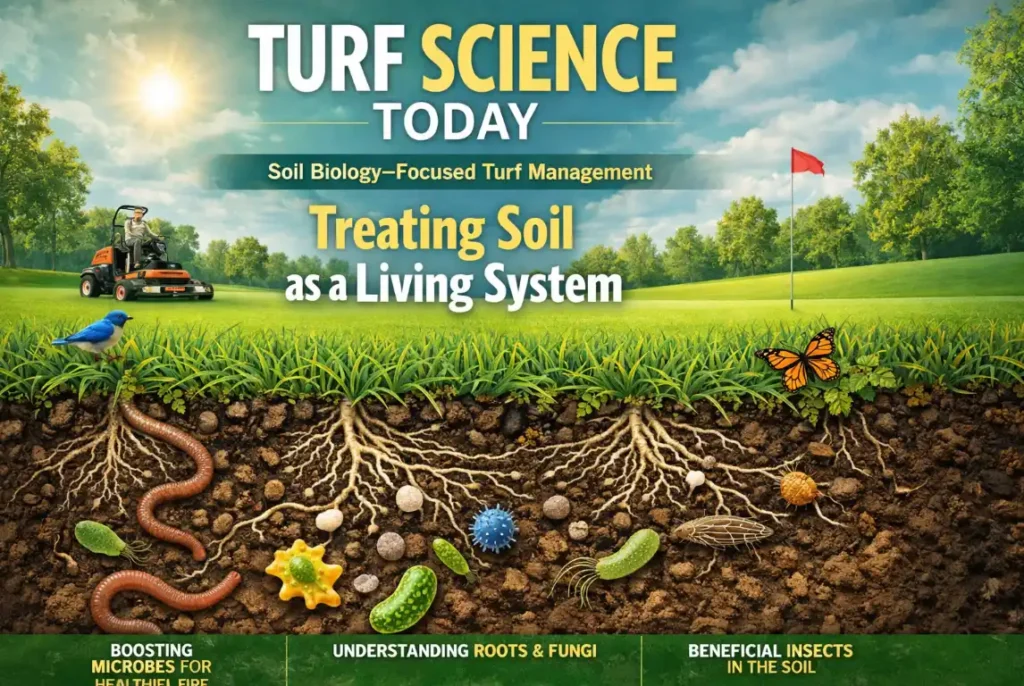
For a long time, turf management focused on what we could see on the surface: colour, density, smoothness, and speed. The concept of soil biology was not widespread. If turf struggled, the solution often came in the form of fertilisers, chemicals, or mechanical work. But by 2026, a quiet revolution has taken place beneath our feet. Soil is no longer treated as a passive growing medium; it is understood as a living system—and one that plays a decisive role in turf health. Modern greenkeeping increasingly starts below ground, in the complex world of soil biology.
A Living Network Below Ground
Healthy turf begins with healthy soil life. Bacteria, fungi, protozoa, nematodes, and countless microorganisms interact every second around grass roots. Together, they form a living network that regulates nutrient availability, water movement, root development, and plant resilience. When this biological balance is strong, turf becomes naturally more stable and resistant to stress.
One of the most important changes in 2026 is the growing use of microbial soil analysis. Instead of looking only at pH, texture, and nutrient levels, greenkeepers are now able to assess biological activity. The balance between bacteria and fungi, microbial diversity, and organic matter breakdown rates all provide valuable insight into how soil actually functions.
Strategic Turf Management: Bacteria vs. Fungi
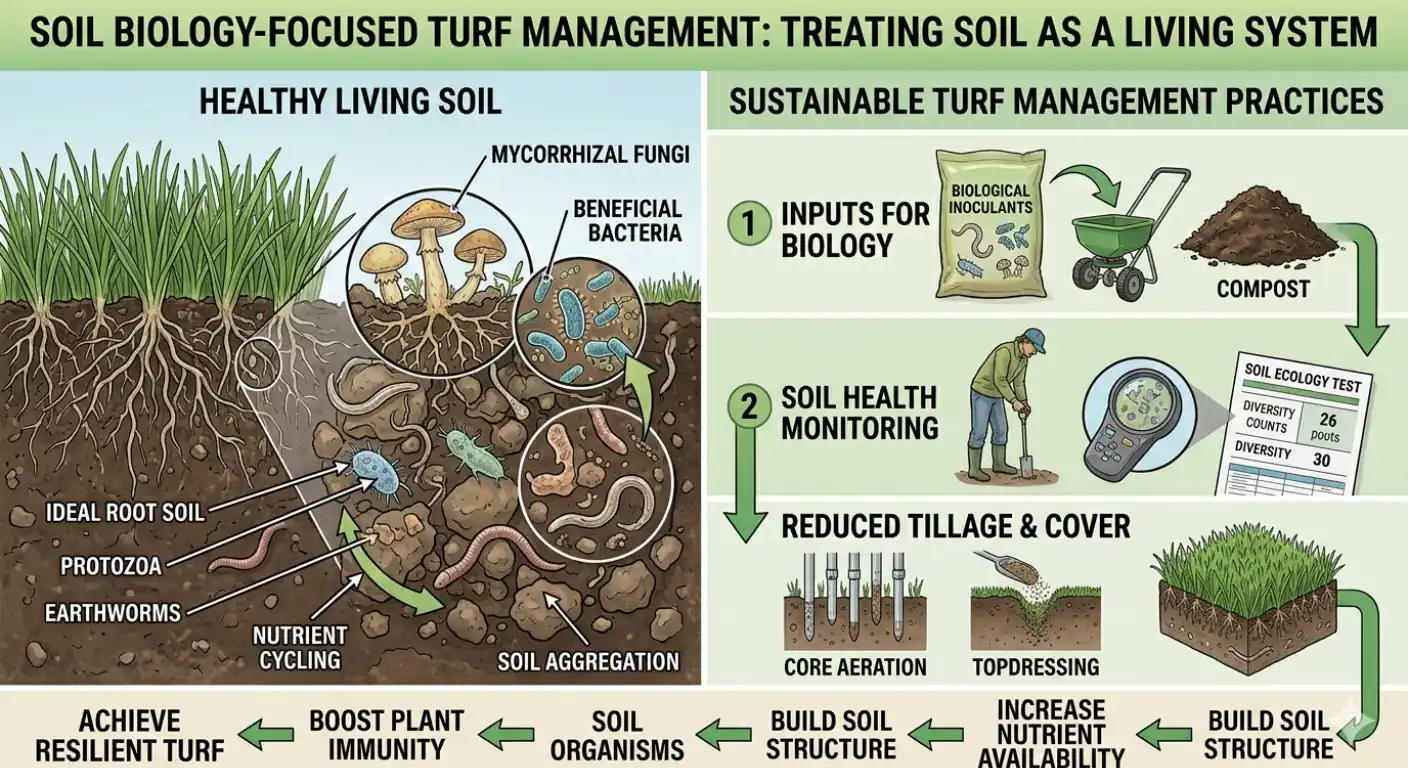
This knowledge changes decision-making. A soil dominated by bacteria behaves differently from one with a strong fungal network. Certain grasses benefit from fungal associations, while others respond better to bacterial-driven nutrient cycling. Understanding this allows greenkeepers to support the soil instead of fighting it.
With this shift comes a reduced reliance on chemicals and a greater emphasis on biological amendments. Compost teas, microbial inoculants, organic carbon sources, and natural biostimulants are increasingly used to feed soil life rather than force a plant response.
The Long-Term Vision
The goal is not rapid visual change, but long-term stability. Biological amendments don’t act overnight. They work gradually, improving nutrient exchange, root function, and stress tolerance over time.
This slower approach requires patience, but it often delivers more consistent results. Turf grown in biologically active soil tends to recover faster from wear, tolerate drought better, and show fewer disease symptoms.
Rethinking the Rootzone
Rootzone management has also evolved. In the past, rootzones were evaluated mainly by texture: sand content, drainage speed, and compaction levels. While these factors remain important, they are no longer the full picture. Today, greenkeepers also consider how biologically active the rootzone is.
Roots do not grow into dead soil. They grow where oxygen, microbes, moisture, and nutrients interact in balance. Excessive sand topdressing, aggressive aeration, or constant disturbance can damage microbial habitats if not carefully managed. In 2026, the focus is on creating rootzones that support life, not just drainage.
Natural Resilience and Disease Suppression
This biological approach directly influences stress resistance. When turf faces heat, cold, drought, or heavy play, its response depends largely on what happens underground. Strong plant–microbe relationships help grasses access water and nutrients more efficiently. Some fungi extend the effective root system, while certain bacteria help regulate hormone responses.
Disease pressure is also affected. Many soil-borne diseases thrive in biologically poor soils. When microbial diversity is high, harmful pathogens face natural competition. This does not eliminate disease completely, but it reduces its intensity and frequency. Instead of reacting with curative treatments, greenkeepers can focus on prevention through soil health.
The Greenkeeper as Ecosystem Manager
This approach fits well with European environmental regulations and sustainability goals. Reduced chemical inputs, lower nutrient losses, and improved water efficiency are not just ecological benefits—they are practical necessities. Courses that invest in soil biology often find they spend less on emergency treatments and reactive fixes over time.
Of course, soil biology-focused management does not replace traditional turf skills. Mowing quality, irrigation accuracy, drainage, and traffic management still matter deeply. What changes is the foundation. When soil life is supported, every other maintenance operation becomes more effective.
Conclusion: A Future Built from the Ground Up
Perhaps the biggest shift is mental. Greenkeepers in 2026 are no longer just surface managers; they are ecosystem managers. Walking the course means observing turf response, moisture patterns, root depth, and soil smell as much as colour and density.
A healthy surface tells a story of well-fed microbes, functioning roots, and soil that breathes. In an era of climate uncertainty, soil biology offers something powerful: resilience built from the ground up. In 2026, the future of turf management is not only smarter—it is more alive.

I live where turf meets tech, science meets sod, and tradition meets tomorrow.
A curious mind with a passion for the ground beneath the game, this space is dedicated to exploring the innovations, breakthroughs, and sustainable practices that are reshaping golf courses worldwide.
From the latest advancements in grass genetics to the most innovative course management tools, I will highlight the ideas that help the industry grow smarter, play wiser, and think long-term for the planet.
The mission is simple: connect the dots between the lab and the fairway, transforming complex science and cutting-edge tech into clear, compelling stories.
Together, let’s make every course better—one groundbreaking story at a time.