
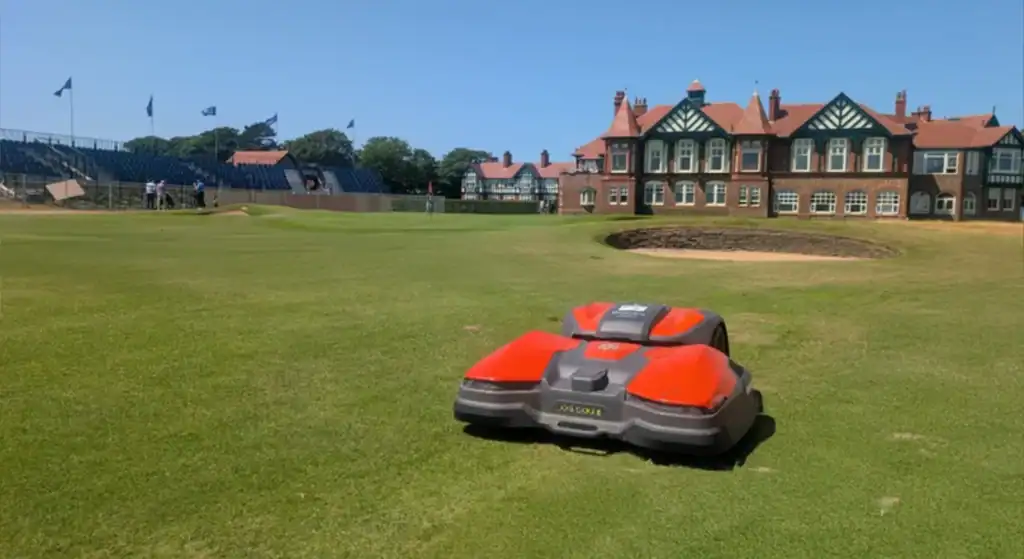
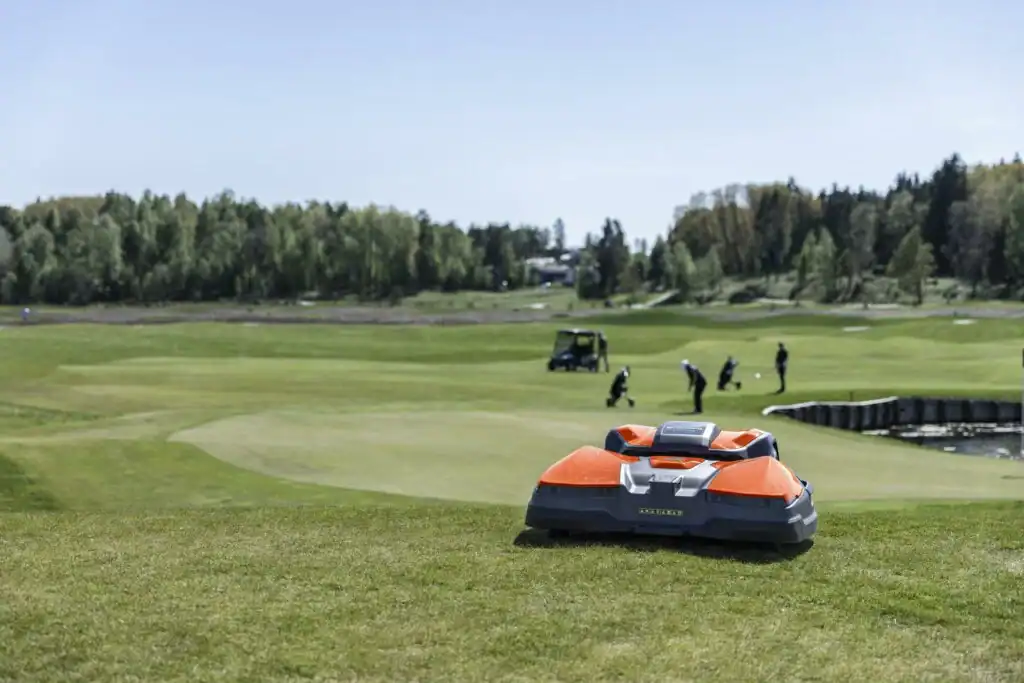
The order includes four Husqvarna CEORA 546 EPOS units and one Automower 580L EPOS, all supplied through Balmers GM Ltd, Husqvarna’s authorised Pro Partner dealer for the region. On top of that purchase, Husqvarna is providing two additional CEORA units specifically to help the green-keeping team prepare in the lead-up to the championship.
That’s seven Husqvarna autonomous mowers working the course in total during the build-up — a scale that goes well beyond a trial or a single test unit tucked away on a practice area.
The CEORA range is Husqvarna’s commercial-scale robotic mower, designed for large surface areas that need dependable, repeatable results without an operator standing over the machine all day. The Automower 580L EPOS is built for more varied or uneven terrain, and both rely on GPS-based EPOS guidance to stay within tightly mapped zones.
Why the AIG Women’s Open Changes the Calculation
Hosting a major changes what “good enough” looks like for a golf course. Fairway lines need to be sharp for television. Surfaces need to hold up under thousands of spectator footsteps. And the maintenance team needs enough hours in the day to handle everything else a championship throws at them — bunker prep, green speeds, rough management, hospitality builds.
That’s the backdrop against which Royal Lytham’s investment makes sense. Husqvarna autonomous mowers don’t get tired, don’t need breaks, and can run overnight or in early-morning windows that would otherwise eat into a human operator’s day. For a club juggling a major championship on top of its normal membership play, that’s not a minor convenience — it’s a genuine operational lever.
It also reflects a broader shift happening across elite venues. Consistent surface quality and operational efficiency are becoming as central to championship planning as bunker design or green speed targets ever were.
Why the AIG Women’s Open Changes the Calculation
Hosting a major changes what “good enough” looks like for a golf course. Fairway lines need to be sharp for television. Surfaces need to hold up under thousands of spectator footsteps. And the maintenance team needs enough hours in the day to handle everything else a championship throws at them — bunker prep, green speeds, rough management, hospitality builds.
That’s the backdrop against which Royal Lytham’s investment makes sense. Robotic mowers don’t get tired, don’t need breaks, and can run overnight or in early-morning windows that would otherwise eat into a human operator’s day. For a club juggling a major championship on top of its normal membership play, that’s not a minor convenience — it’s a genuine operational lever.
It also reflects a broader shift happening across elite venues. Consistent surface quality and operational efficiency are becoming as central to championship planning as bunker design or green speed targets ever were.
Building on Royal Porthcawl’s 2025 Breakthrough
Royal Lytham isn’t the first major venue to lean on Husqvarna’s robotic fleet. At Royal Porthcawl, during the 2025 AIG Women’s Open, CEORA mowers were given responsibility for cutting all 18 fairways across the entire tournament.
You may also like

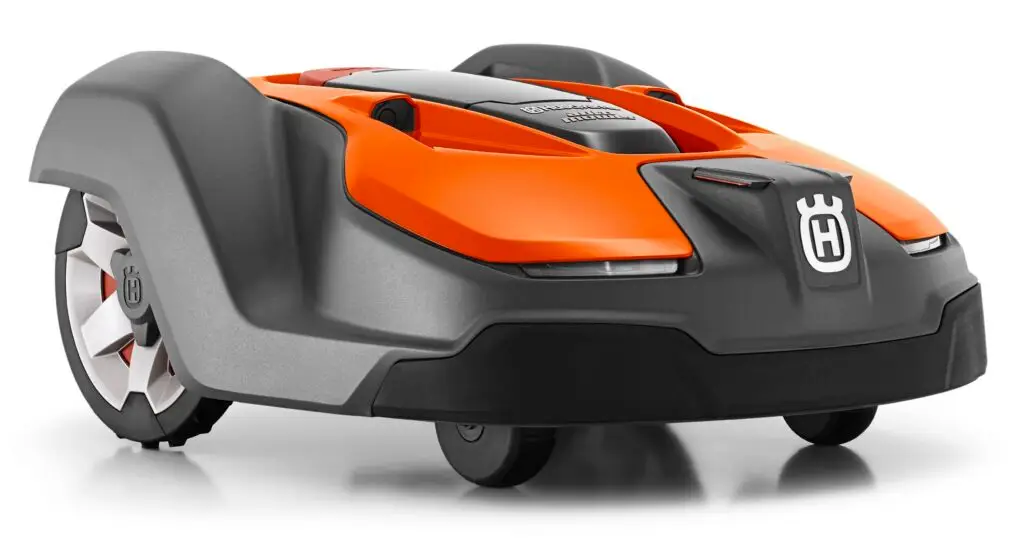
That was a first for The R&A — the first time autonomous machines had been trusted with full fairway-cutting duties at a major championship. It wasn’t a supporting role; it was the main job, done without human hands on the machine.
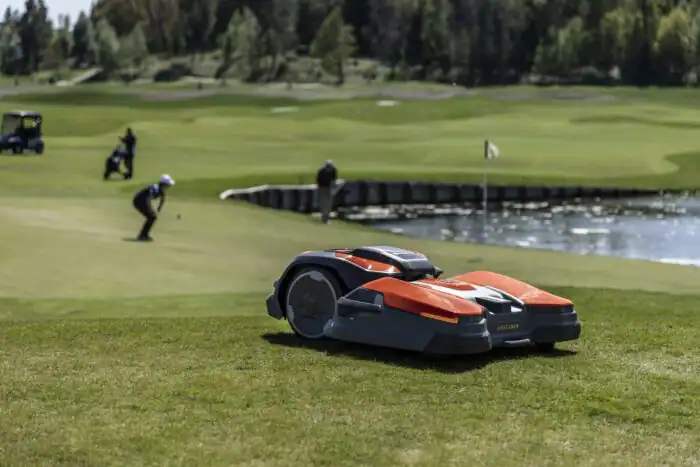
Royal Lytham’s decision to bring in a larger fleet of Husqvarna autonomous mowers ahead of its own AIG Women’s Open builds directly on that precedent. Husqvarna has been open about wanting this to become a pattern rather than a one-off: a standard piece of the toolkit at elite championship venues, not a novelty reserved for a single showcase event.
How Husqvarna Autonomous Mowers Actually Work
It’s worth unpacking what’s actually happening under the hood, because “autonomous mower” covers a fairly wide range of technology, and Husqvarna’s EPOS system is more sophisticated than the robotic mowers many greenkeepers will have seen on smaller domestic lawns.
EPOS stands for Exact Positioning Operating System. Instead of relying on a buried boundary wire — the traditional way robotic mowers know where to stop — Husqvarna autonomous mowers using EPOS technology rely on GPS-based positioning to follow a digitally mapped course layout. That mapping can be updated remotely, which matters enormously on a golf course where cutting zones, hole locations, and event infrastructure change week to week.
Key features of the CEORA and Automower EPOS range:
- GPS-guided navigation — machines follow a precise, virtually mapped boundary rather than a physical wire.
- Remote zone management — course staff can adjust cutting areas from a central system rather than digging up wire on the ground.
- Continuous, low-impact cutting — frequent, shorter cuts rather than infrequent heavy cuts, which supports finer turf health over time.
- Scalable fleet operation — multiple units can be managed and monitored together across large areas of the course.
The Automower 580L EPOS is the more versatile of the two models here, built to handle rougher or more varied terrain than the commercial-scale CEORA units, which are optimised for large, flat expanses like fairways.
A Course Built for This Kind of Scrutiny
Royal Lytham & St Annes isn’t a new name in championship golf. The club has hosted the Open Championship eleven times since 1926, along with multiple Ryder Cups and other major professional events. Its flat, out-and-back links routing and famously punishing bunkering have made it one of the sport’s most recognisable tests.
That history is part of why this deployment carries weight. A course with Royal Lytham’s championship pedigree isn’t short of experience judging what does and doesn’t hold up under tournament pressure. Its maintenance team has spent decades refining preparation for events watched by a global television audience, and it’s that same team now vouching for Husqvarna autonomous mowers as part of the plan.
It also means Royal Lytham has less margin for error than most clubs experimenting with new equipment. A course of this profile isn’t going to risk fairway presentation on unproven technology days before a major. The scale of this deployment — five purchased units plus two more on loan — suggests genuine confidence rather than a cautious toe in the water.
You may also like
What the Industry Is Saying
Jonathan Snowball, who heads Husqvarna’s Professional division for the UK, described Royal Lytham’s decision as a significant marker for the technology. A club with that level of history and standing choosing Husqvarna autonomous mowers ahead of hosting a major, he suggested, says something real about how far the technology has come — and where turf management as a whole is heading.
Andrew Meeks of Balmers GM Ltd, the dealer that supplied the units, framed it in similar terms. He pointed out that a club with Royal Lytham’s profile backing this technology reflects just how much confidence now exists in it at the very highest level of the sport.
Those comments matter less for the flattery and more for what they signal: dealer and manufacturer alike are treating this as evidence the technology has moved past the pilot stage for elite venues.
Inside Royal Lytham’s Hybrid Maintenance Model
Perhaps the most practically useful comments come from the club’s own Course Manager, Paul Smith. He’s described the robotic fleet as helping the club deliver a more consistent cut year-round, with knock-on benefits for turf health and for easing pressure on the wider maintenance workshop.
Crucially, Smith frames the addition of Husqvarna autonomous mowers to the toolkit as a enhancement rather than a wholesale replacement of traditional methods. Royal Lytham has built what he calls a hybrid maintenance programme — combining conventional cylinder mowing with robotic units to draw on the strengths of each.
That distinction matters for any greenkeeper reading this and wondering whether robotic mowers mean retiring the fleet of cylinder mowers altogether. At Royal Lytham, the answer so far is no. The robots are handling the repetitive, high-frequency cutting that eats up staff time, freeing the team to focus their skilled labour where it adds the most value — fine-tuning presentation, managing bunkers, and handling the countless small jobs that only a human eye catches.
What This Means for Course Maintenance Going Forward
Two major venues committing to autonomous fairway mowing inside a single year is not a coincidence. It looks like the start of a pattern that other championship courses will be watching closely, particularly as pressure grows on maintenance budgets and staffing across the golf industry.
If Royal Lytham’s deployment performs well through the AIG Women’s Open, expect more clubs at that level to integrate Husqvarna autonomous mowers into their operations. The economics are straightforward: robotic mowers reduce the labour hours needed for routine cutting, which lets clubs redeploy skilled staff toward the parts of course presentation that genuinely need human judgement.
For greenkeepers at clubs of any size, the more interesting takeaway may be the hybrid model itself. Full automation isn’t the goal here — a blended approach that pairs robotics with traditional cylinder mowing, matched to each job’s specific demands, looks like the more realistic template for most courses to follow.
The Efficiency Case Behind Husqvarna Autonomous Mowers
Beyond presentation, there’s a quieter argument playing out here around cost, labour, and sustainability — one that matters to greenkeeping teams well beyond the championship circuit.
You may also like
Traditional petrol-driven fairway mowers require a dedicated operator for every hour of cutting. On a course the size of Royal Lytham, that adds up to a significant chunk of a maintenance budget spent simply moving machinery across grass that needs cutting several times a week regardless of the weather or the calendar.
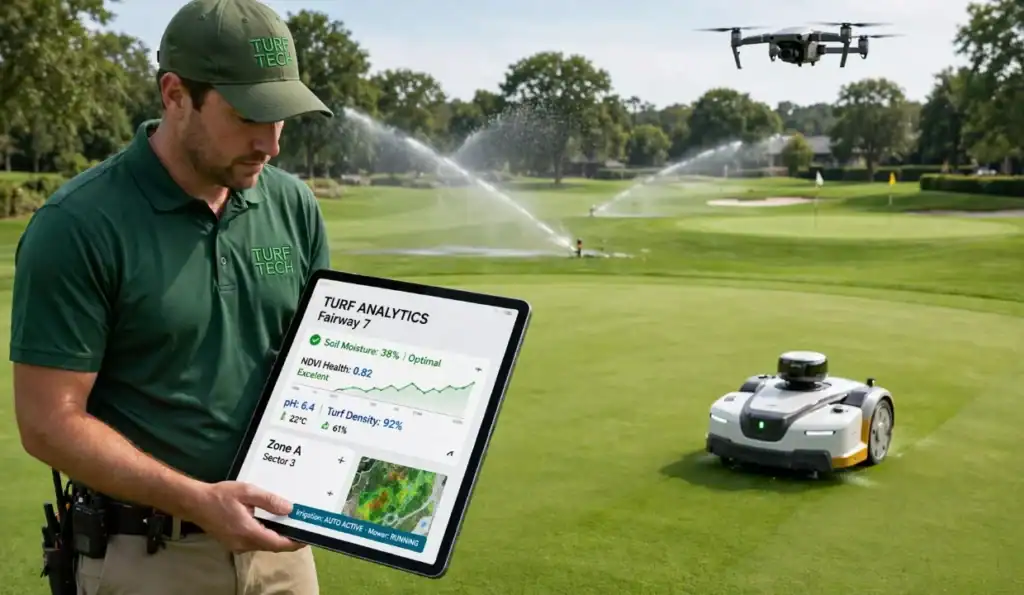
Robotic units change that equation. A fleet of CEORA and Automower machines can run through the night or in the early hours before members and spectators arrive, cutting continuously in short, frequent passes rather than one longer weekly cut. That pattern tends to produce a finer, more even sward over time, since the grass is never allowed to grow long enough to stress the plant between cuts.
There’s an environmental angle too. Husqvarna autonomous mowers in this range run on battery power rather than petrol, cutting fuel use and emissions across a fleet that would otherwise be running combustion engines for hours each day. For clubs under pressure to demonstrate sustainability credentials — something increasingly asked of major championship venues — that’s a tangible, measurable benefit rather than a marketing line.
None of this replaces skilled greenkeeping. Bunker raking, green speed management, disease monitoring, and the countless judgement calls that go into tournament-ready presentation still need experienced staff. By assigning routine tasks to Husqvarna autonomous mowers, clubs fundamentally change where staff time gets spent — moving away from repetitive cutting and toward the parts of the job that actually require a trained eye.
FAQ
What robotic mowers is Royal Lytham & St Annes using?
The club has purchased four Husqvarna CEORA 546 EPOS units and one Automower 580L EPOS, with two further CEORA units supplied by Husqvarna to support championship preparation.
What does EPOS mean in Husqvarna’s mowers?
EPOS stands for Exact Positioning Operating System — a GPS-based navigation method that lets the mowers follow a digitally mapped course layout instead of a buried boundary wire.
Has a robotic mower cut fairways at a major championship before?
Yes. At Royal Porthcawl during the 2025 AIG Women’s Open, Husqvarna CEORA mowers cut all 18 fairways throughout the event — the first time The R&A had given that role to autonomous machines at a major.
Will Royal Lytham stop using traditional cylinder mowers?
No. The club has built a hybrid maintenance programme that combines robotic mowing with conventional cylinder mowers, using each where it fits best.